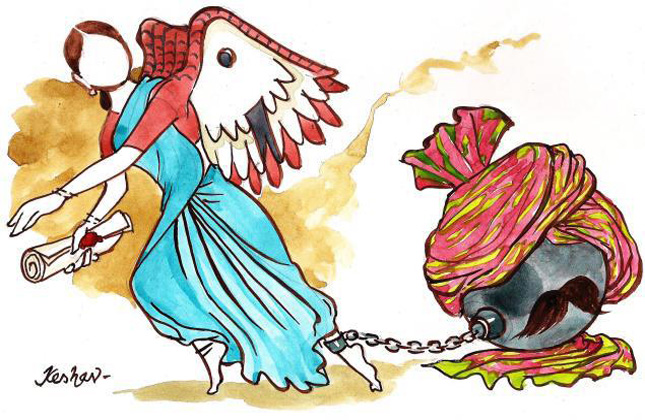
Behind every successful man, There is a woman
A woman is the full circle. Within her is the power to create, nurture and transform
You are more powerful than you know, you are beautiful just as you are.
These are some of the quotes that we might have searched on google for writing content on women empowerment. Are these quotes really accepted in a country where 80% of population worships Goddess of different kinds(I am talking about India)? Do you know the conditions of women in India? Okay, let me aware you with some conditions based on facts and figures-
Here’s a list of some of the most horrific rape cases that have already been recorded in the first half of 2019.
A 16-year-old girl was gang raped for 5 days in Andhra Pradesh.
A 19-year-old girl from Bihar was allegedly gang-raped by 6 men in front of her father.
A 12-year-old Dalit girl was allegedly raped and then beheaded by her 3 brothers and uncle in Madhya Pradesh’s Sagar district.
A 4-year-old girl was raped in Aligarh after the accused lured her with ₹10 note and took her to a secluded spot.
A 11-year-old girl was raped and murdered in Unnao and her body was found lying in an orchard.
A 3-year-old girl was allegedly raped by her 11-year-old neighbour in Dehradun when the girl’s parents were not at home.
A 13-year-old girl was raped by 2 men at her home in Shahjahanpur when her parents had gone out to purchase medicines.
A 9-month-old girl was raped in Telangana after the man took her to a secluded place in the wee hours.
A 4-year-old girl was raped in a private school in Punjab.
A 17-year-old deaf and dumb girl was allegedly raped by 3 men in Rampur who also filmed the act.
A 16-year-old girl was kidnapped, confined and raped by 3 men in Noida for 51 days.
A 6-year-old girl was raped and murdered by a drunk teenager in a Hyderabad village after she went missing while playing Holi.
A 7-year-old girl was raped and murdered in Kannauj after being abducted from a temple near her house.
A woman was repeatedly gang-raped at a farm house in Ludhiana after she and her husband were abducted, looted and beaten up.
A 4-year-old girl was raped and murdered after being kidnapped from a slum in Indore.
Are you angry?? wait wait.. Let me give you some more content.
The share of female enrolled in higher education in India was just over 23 percent in financial year 2015. There was an increase in the number of female students enrolled in higher education institutes across India since the passing of the Right to Education Act in 2009. However, this does not consider that many female students, especially in rural areas, drop out of school before even completing their elementary education. The root cause for the decline in the number of educated women in India was attributed to gender inequality lying at the core of social norms and the education system.
the average life expectancy of women at birth in India was about 70.43 years.
In 2019, it is projected that the average share of women in parliaments around the world stood at 24.3 percent, up from 13.3 percent in 2000. India ranks 20th from the bottom in terms of representation of women in Parliament.
The highest employability among female graduates was in the retail sector with 50 percent, and lowest in the manufacturing and oil/gas power sectors with nine percent each during the measured time period.
A youth survey conducted among 15-34 year olds across 19 states across India in 2016 about their attitude towards women working after marriage. About 20 percent of respondents agreed that it was not right for women to work after marriage, while a majority of young adults disagreed with this statement during the survey period.
440,000 entries of cases that have been reported since 2008.
The wage gap between Indian men and women is amongst the worst in the world, a report by international confederation of charitable organisations, Oxfam, said. The Monster salary Index (MSI) says, Indian men earn 25% more than women in the same kind of work done by both men and women. The average gender gap is 38.2%. However, Accenture research says that the gender gap in India is as high as 67%. More than 47% of women in India are involved in Agriculture related works, however the wage gap is beyond comprehension, because of non-uniformity in sectors, which is the same for other unorganized sectors in India.
Women’s participation in the force is quite low, and has been falling over the last few years. The female to male ratio is only 0.36
Given to India’s patriarchal nature, domestic violence remains as culturally accepted because of cultural and religious reasons. In a survey with young men and women in India, 57% of boys and 53% girls accept women beating by husbands is justified. In another recent survey between 2015-2016, it revealed, 80% of working women suffer domestic violence at the hands of their husbands
India is ranked 105 amongst 128 countries in its Education for All Development Index. Among SAARC nations, India stands third behind Sri Lanka, and Maldives. India still has one of the lowest female literacy rate in Asia. As per the India’s last census in 2011, the female literacy stands at 65.46% compared to 82.14% of males. estimates show that for every 100 girls in rural India only a single one reaches class 12 and almost 40% of girls leave school even before reaching the fifth standard.
India reports 104 rape cases daily in which 40% rape victims are minor.
According to the survey on 2018 by Thomas Reuters Foundation, India is world’s most dangerous country for women. Thomas Reuters is world’s biggest network based in canada. Its main focus is on journalism about women’s right, climate change and child trafficking and they carry out their researches on these subjects. This particular survey ” world’s most dangerous country for women” according to them is a perception poll and it’s not based on any data or poll. This is based on perception of not any local individual but of experts i.e. How the experts feel about a country, what is their opinion, perception about it. One thing to keep in mind that if we ask perception of a commoner then it is based on his surroundings, experience, but if you ask an expert about the perception then it’s of a very higher value as an expert is working in that field, researching on facts everyday about it and that creates a difference so as his perceptions and opinions are generally based on facts.
So total of 548 experts were surveyed out of which 41 were from India and they answered questions for ranking based on different categories like sexual violence, human trafficking, non sexual violence, human cells etc. based on these categories , they had given the final ranking of the world’s most dangerous country for women. So based on these experts perception, India is ranking no. 1 in 2018 amongst 192 countries. #2- Afghanistan #3- Syria #4- Somalia #5- saudi Arebia ,#6- Pakistan.
This survey based on perception was done in 2011, that time India’s rank was 4.
If we breakdown these categories then India was ranking #1 at Sexual violence, Human trafficking , culture and religion against women ( child marriage, acid attack etc.) , #3 at discrimination which includes discrimination against women in the daily life like in education, in job etc. , #3 for non- sex violence and #4 at health across.
Now the question is how credible and truthful is this. Talking about credibility, Thomas Reuters is a very credible organisation which won many awards like Asian Environmental Journalism Award in 2015 for excellent environmental reporting, it also recieved United Nations Foundation Prize etc. This organization providing training to journalist in more than 170 countries.
There is a question arise, Why is there a perception based survey and why not the reports are based on data and statistics? When it comes to crime data, then stats and data don’t make sense. e.g. Kerala has the highest crime rate in comparison to other states but that does not mean when you go there, you find violence. Infact it’s the highest because people are reporting these cases and hence kerala comes under one of the safest states. The same thing applies on other countries also. If you compare crime rates based on facts and stats, then you would not find the actual crime rate.
If you look European countries like sweden, Botswana, then the crime rate of women is highest but that does not mean these are the dangerous country for women, Infact it is the opposite as people are reporting here. We will never find actual cases as many of the cases are not reported or written anywhere.
That’s why, taking expert decision into account is a good idea.
In 2017, Indian National Bar Association took a survey of 6047 women and realised that 70% of Indian Women are afraid of registering their sexual harassment cases. So here you can find how many women are afraid and there will be many cases which would have been denied by police.
So basically it cant be said that India deserve 100% to be on rank 1 or not because these experts also has some limitaitons which people have pointed out. Like its not been revealed which field does these expert belongs to and what are their qualifications? So its not so transparent. But apart from limitations if we consider facts, then if not rank 1 but it lies between 1 to 10 by looking at current scenarios.
e.g. Female foeticide which is related criteria on the basis of which this consensus could be drawn then India is no. 4 worst country in 2016. This can be found out by looking at the sex ratio at birth. which is 112 males to 100 females.
Other countries- 106:100 (Syria), 104:100(afghanistan), 102:100 (somania).
Top 3 countries that rank worst than India in birth sex ratio are Leichtenstein, china and Armenia but these counties don’t have those problems like Crime against women and all that’s why India’s rank goes to the highest point.
Dowry related death: According to National crime Bureau, every year more than 8000 women dies due to dowry in India.
But many people like the one who was trying to find nano chip in our 2000 rupees note, sudhir chaudhary said that anti- India agenda has been started by this organization but if we see the tweet of PM Narendra modi of 2 oct 2013, then he wrote ” India is considered 4th most dangerous for women, and this was based on the same survey, considering the fact that many of the persons at that time was complaining but now, because Mr. Narendra modi came into power they call it anti-India agenda. The same thing was written by BJP’s MP Rajiv Chandrasekhar in 2014 and Amit Malviya in 2013, and now in 2018, they opposed it fully.
As we can see, for the first time we are witnessing rally against a rapist, religion has been interfered in rape case (kathua rape case).
Some more reasons– Psychologist Madhumita pandey has interviewed 122 rapists in Tihar jail in 2013 to know why they rape?. In her interviews she said, most of the convicted rapists presented themselves as nonrepentant and attempted to justify their crimes.
According to Mukesh Kumar, convicted on Nirbhaya case, said A decent girl won’t roam around 9o’ clock at night. A girl is far responsible for rape than men. You can also see speeches on Asaram Bapu on Nirbhaya case.
Believe it or not, there are many bollywood songs and scenes which should not be used. Even Australian man accused of stalking escapes conviction after blaming Bollywood according to THE TELEGRAPH.
Solutions- – Accept the problem—First step to solve any problem is to accept the fact that the problem exists as our government has denied that report.
Thompsons Reuters organization’s CEO has given the solution in three words- EDUCATION, EMPOWERMENT, ENFORCEMENT.
In Nairobi, Kenya, every four girl (25%) had been through sexual assault , so they ran No means No campaign classes to the students which resulted in 40% decrease in rapes.
Now, I am looking for you to provide some suggestions and ideas in the comments to be implemented to curb this problem..
 SANJAY KUMAR