Since the original iPhones launched 13 years ago. A lot of people have been waiting for Apple’s next big product category. Since then we’ve had the iPad ,Apple watch and ear pods. These have all sold well, but I think Apple’s next venture into augmented reality might be more interesting.
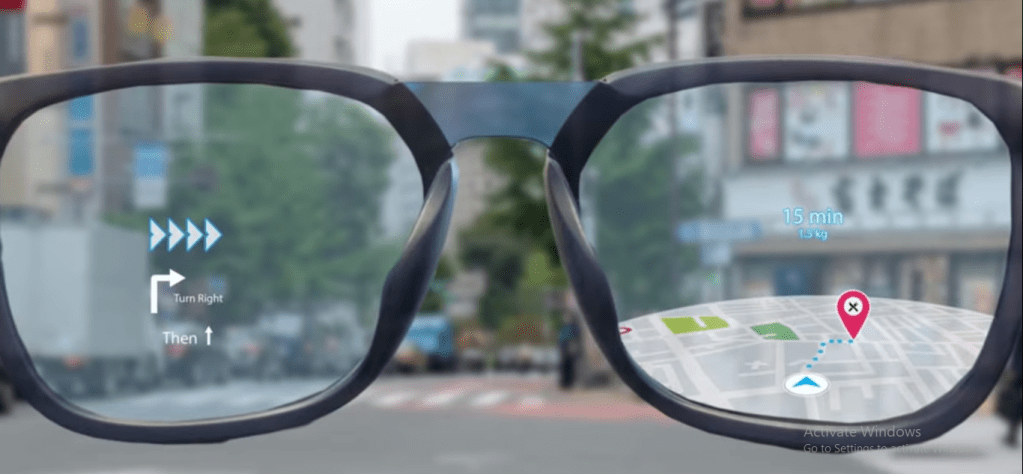
Augmented reality is a technology whose goal it is to augment or enhance one’s physical environment by adding digital elements. This new industry has started maturing and Apple stepping in with a pair of augmented reality glasses may be a game changer. The details of these glasses were recently leaked. So what can Apple bring to the space ?
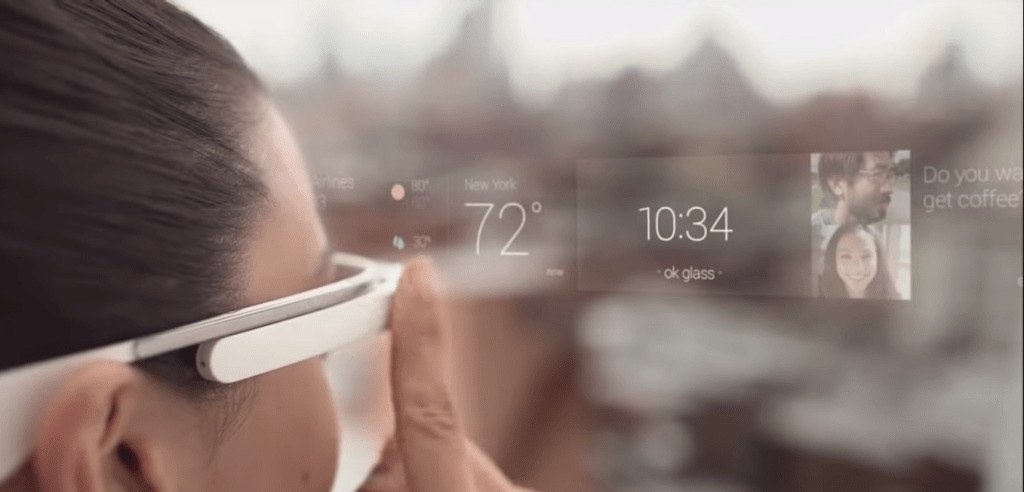
We know that Apple has been exploring virtual and augmented reality technologies for more than ten years. The company has established a secret research unit comprising of hundreds of employees including members from companies such as Microsoft, Lytro, magic leap, oculus and Organizations such as NASA and Virginia Tech. They’ve also acquired a bunch of companies in the AR and VR space. From Google glass and snapchat spectacles to hololens, magic leap and Facebook’s upcoming AR glasses, many have tried and are trying to make this technology work and the landscape could Suddenly get very crowded very fast But so far, it’s mostly been in vain. There hasn’t been any mainstream success beyond the dedicated tech community and Apple may change it.
We know that there’s one thing that Apple is good at is making technology simple for the masses. In the 80s they changed personal computing by popularizing or stealing depending on how you look at it. Xerox is graphical user interface It changed computers from lines of text that were often Confusing frustrating and error-prone into a graphical interface that everyone could understand.
In 2001 they made portable music less of a chore to navigate and Of course in 2007 Apple made smartphones accessible. They took the clunkiness out of the user interface. Before the iPhone it was the buttons of a blackberry or the frustrating touchscreen of an LG Prada. capacitive multi-touch changed the game. All of this is to say having Simplicity at the core has proved to be a successful strategy for Apple and a new product category like augmented reality. Is the perfect arena to push the strategy further?
Lika John, Prosser says that these new glasses will be called Apple glass. He mentioned that the product will look similar to Ray Bans or the glasses that Tim Cook wears. He describes them as unintimidating a factor that I think will be very important The price is said to be $499 plus prescription fees, which is surprising for Apple for instance microsoft’s hololens 2 has a price tag of $3500.
Much of that cost comes from all the electronics needed to run the AR experience being built into the headset itself. On the other hand Apple glasses are said to be run from the phone much like the first generation Apple watch But we’ll get to this later . Each lens is said to have a resolution of 8k which puts it above most TVs. The release date for the glasses is said to be around 2022.
According to the leaks There’s going to be no cameras on the glasses for privacy reasons in the context of wearing glasses. Having a camera pointed at you when someone is looking at you will be off-putting to many and this problem was one of the main reasons why Google glass failed so if there’s no camera the question has to be asked how will Apple glass be able to see the environment to make all of the AR happen.
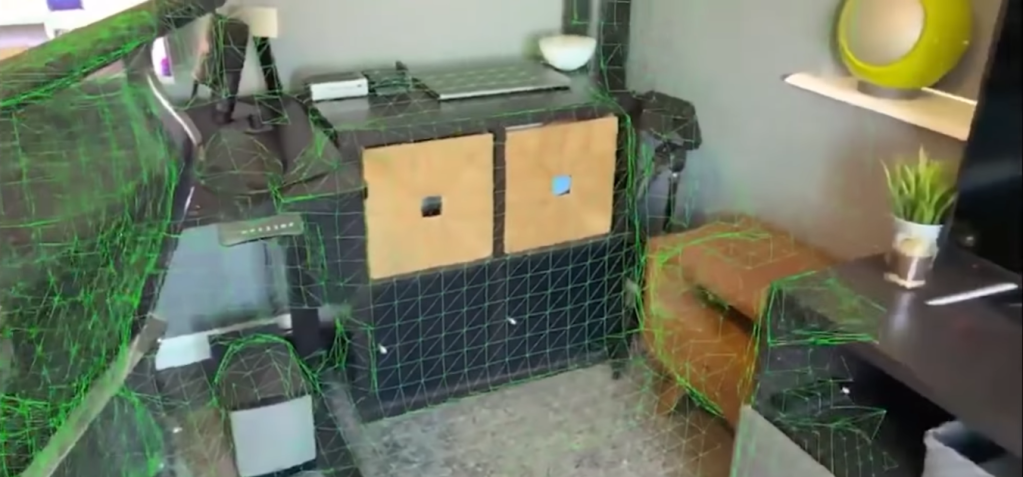
Well, that’s going to be done with a technology called LIDAR( laser imaging detection and ranging) It uses lasers to scan an environment and visualize distance and the shape of objects It’s similar to how bats use sound waves to quote see their surroundings. LIDAR sensors are also used in self-driving cars. Apple already uses this technology in their latest iPad pro in the iPad pro.
The LIDAR scanner is already good enough to create a detailed mesh of its surroundings. It can recognize furniture, people and more. The iPad pro and the next iPhone could end up acting like a development kit for the glasses sensors. Analyst Ming chiku expects the AR glasses to be marketed as an iPhone accessory and as mentioned the Computation processing networking and positioning data will all be offloaded to the iPhone.
The iPhone already has AR and computer vision Computation ships built right in so it seems like Apple designed these phones with the glasses in mind Offloading all the processing to the iPhone will allow the glasses to remain slim and lightweight.
According to a Bloomberg report there’s a new Apple patent that allows the streaming of information from your phone to your face specifically the glasses quote are expected to synchronize with aware as iPhone to display things such as text emails maps and games over the users field of vision end quote Apple also has plans for third-party apps and is considering a dedicated app store you could easily imagine navigation software or the enabling of home entertainment on a Reese callable virtual TV.
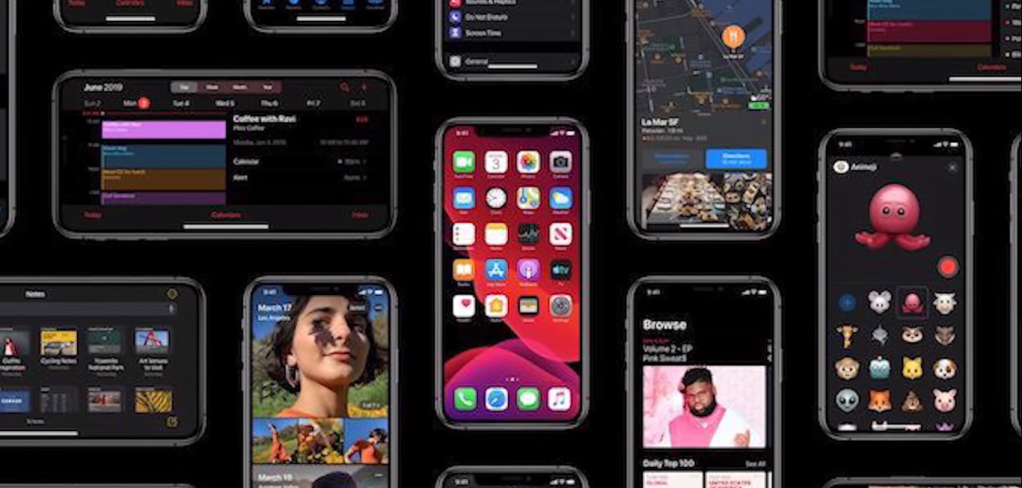
According to another patent, the system will be capable of identifying vision problems and automatically adjust the refraction of the displays and lenses to help a user see. This eliminates the need to wear prescription lenses beneath the augmented reality device . Bloomberg has also said that the glasses will run on ROS or reality operating system, is said to be based on iOS. There’s already code in iOS 13 indicating a stereoscopic software called star board. This takes a bit of its name from the springboard which is what the iPhones home screen interface is called IOS 14 is said to have support for a handheld controller remote.
There are displays in both lenses and the user interface can be controlled by performing gestures on the frames or by using your hands in front of them? Augmented reality apps and games have been available since iOS 11. AR kit has demonstrated that Apple already has all the tech to do this today and these software releases may have been in preparation for the glasses. Since the launch of this new product category and platform is still a while away, the details could be subject to change that being said the information and leaks are very interesting as someone who’s happy to see consumer tech progress. I’d love to see how Apple goes about tackling the AR problem. Their thoughts of simplicity and attention to detail when it comes to user experience could go a long way in pushing augmented reality into the mainstream……………………………………..
It’s been almost 2 months, the country is on full lockdown, As a result , the economic wheel of a country has slowed down. It is the Economically Weaker Section and low group income people who are badly effected. Although everyone is effected in some or other way, but people belonging to this category of socio-economic strata are more vulnerable.
In this blog, we will discuss about the economic impact of migrant workers.
First, we need to know 1) what is migration?
Migration is the movement of anything from one place to another but here we will talk about human migration.
2) How do we know who are migrating?
GOI collect this data from census which is done for every 10 years, Government takes the note of government by looking the current place of residents, if its anywhere other than their last residents, then it is counted but Today there are other ways to count. e.g. from your employer, any utilities or services that you are availing which requires your ID proof, that’s how government can easily figure out whether you are a migrant or not? but primarily it was through the census data.
Now, migration can be seen from four angles-
Intra-district 2) Inter-district 3) Inter- state 4) from abroad
Here, we will talk about domestic one and we will exclude ” from abroad”
Intra – district– It refers to the movement between a single district ( 1,2 cities, few towns, villages)
Inter-district– Movement between two district . e.g. Punjab has 22 district. so people can move from one district to another within a state.
Inter-state– Movement from one state to another . e.g. from Jharkhand to Maharashtra
3) Why people migate?
This can be broadly categorized into Pushfactor and Pull factor
People move from one factor to another factor, only if they find value in it.
Push factor- These are causes or situations which make people to leave that place. It can be poverty, unemployment, lack of basic infrastructure like healthcare, education etc. Apart from these factors, natural disasters like flood, cyclonic storms, T sunami, earthquake etc. are also some of the reasons behind push factor.
Pull factor- These are causes or situations which attract people from different places. This is opposite of push factor. e.g. hope of better opportunities, work with relatively higher wages, better opportunities for education, healthcare etc.
There are 4 streams that identified under internal migration-
R-R R-U U-U U-R
When someone move from R-R (Rural to Rural ) area, they move in the search of better opportunity, education , coachings etc. These are categorized into pull factor , and for U-U, people move for better economic opportunity like better job, institutions etc.
Look at the economic division of a society-
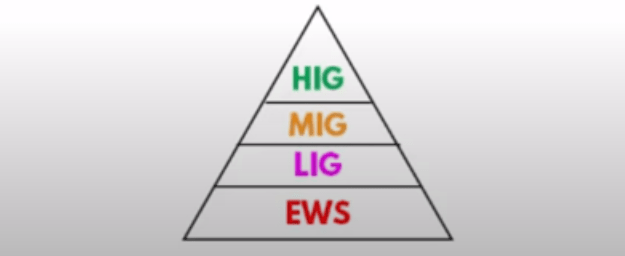
High income group, Middle income group, Low income group, Economic weaker section.
Government using these division for various housing schemes. Migrant can be put into anyone of the division.
workers who migrated from one state to another are more vulnerable as compared to them who migrated within the district as we have seen in the lockdown where those persons are not able to reach home.
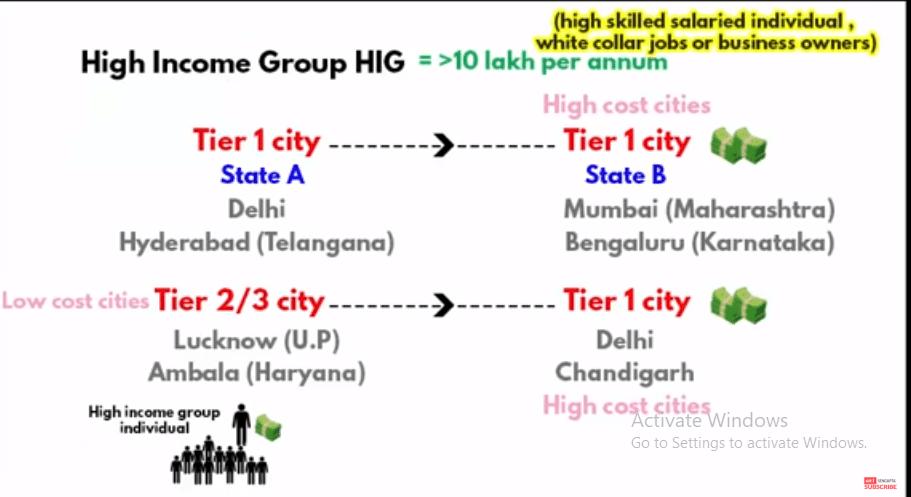
As we can see from the picture, that mostly HIG people move from Tier 1 to Tier 1 city or Tier 2/3 city to Tier 1 city. Mostly HIG people have a salary of approx 10 lakh per annum ( Roughly estmation, not exactly).
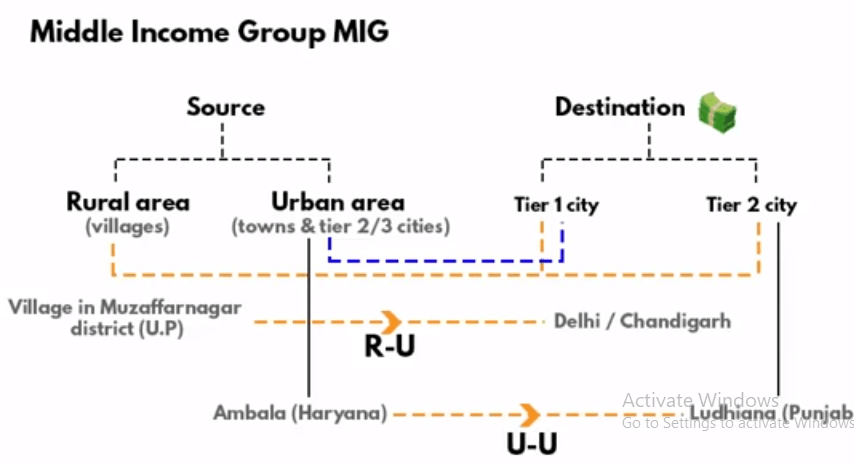
The above picture describes about the migration of a MIG people from R-R or U-U area. Pls see the picture, you will understand better.
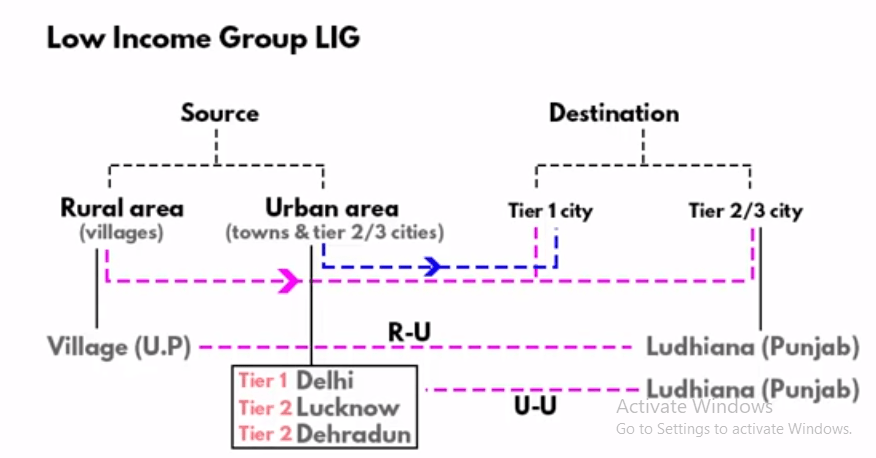
A person who works on luhiana in a manufacturing plant has originated from a village UP is a example of R-U migration
Similarly, a person working in a manufacturing plant of ludhiana migrated from other states or union territories like Delhi, Lucknow, Dehradun etc. due to pull factor. It is for U-U people.
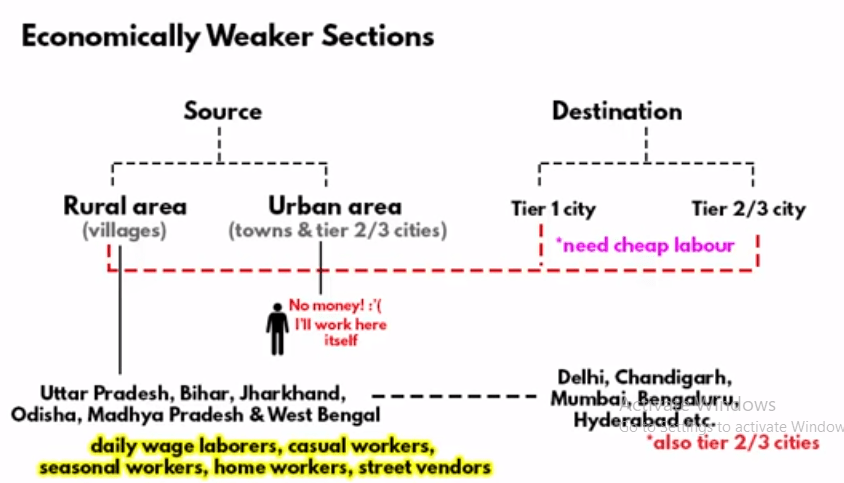
From the above picture , we can understand about the EWS movement which are mostly from rural areas like UP, Bihar, orrisa etc. and they are daily wage workers, laborers etc. They move from rural area to urban area for their livelihood and to earn money.
As we can see, during the lockdown, somehow HIG, MIG people survived because of their savings, full salary and partial salary and they also have their accomodation on the respective states so they need not to be worry compared to LIG and EWS people.
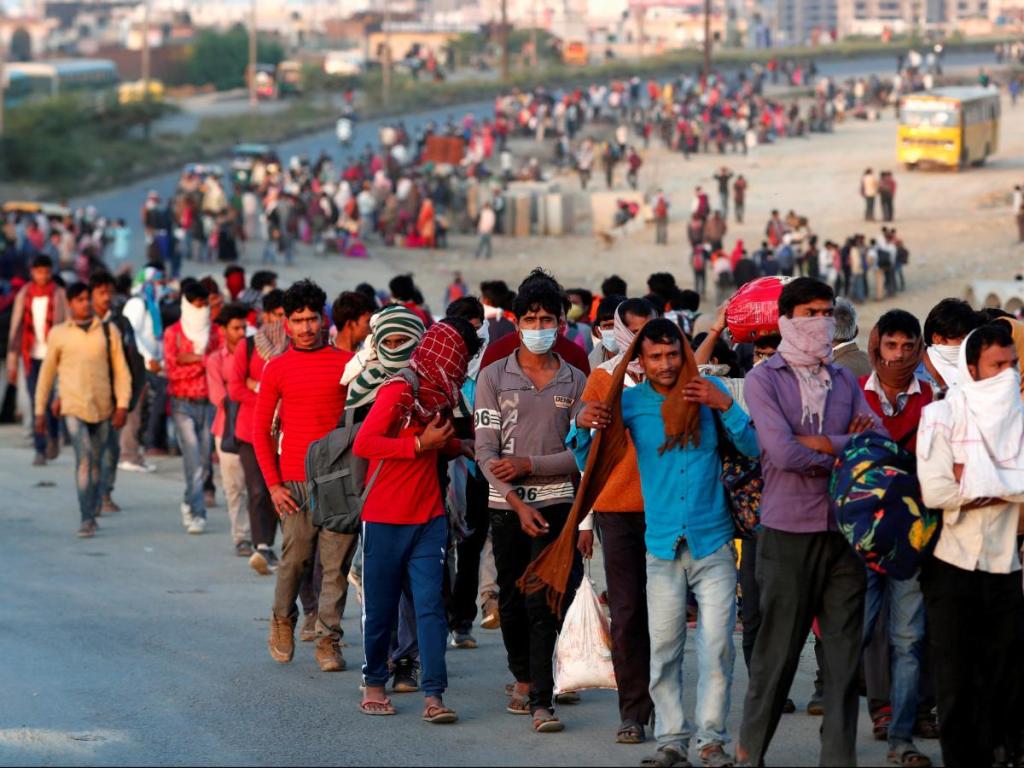
But the EWS and LIG people are badly effected because of their daily wages, informal income etc. They are daily wage workers, casual workers, seasonal workers, home workers , street vendors etc. who are mostly from rural areas. Due to this lockdown they are not able to earn money in this high-cost big cities nor they are able to go back to their villages because all the long distant transportation are shut, as a result you might have seen that many migrant workers trying to get back to their homes by walking 700 , 800 and more kilometers.
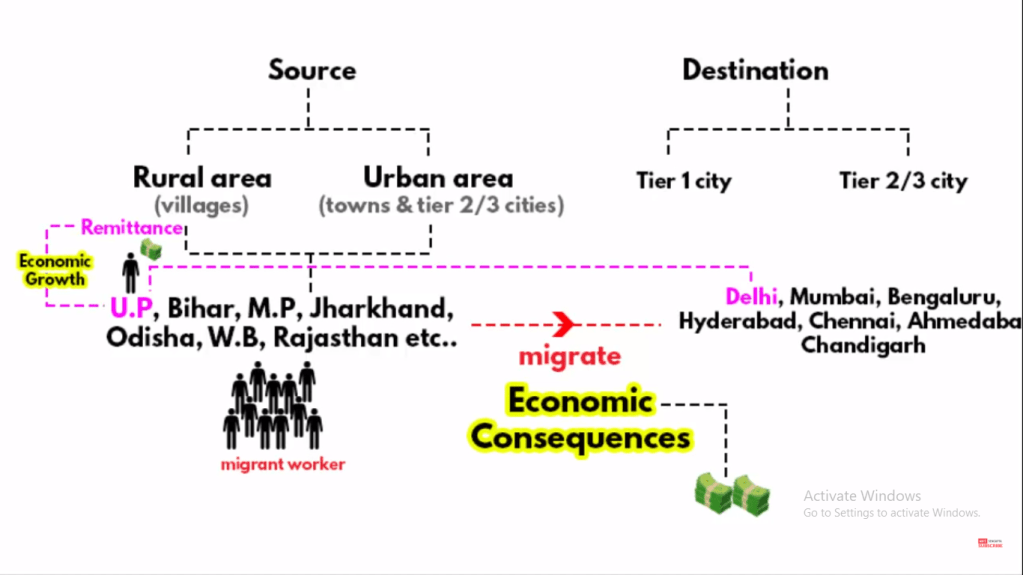
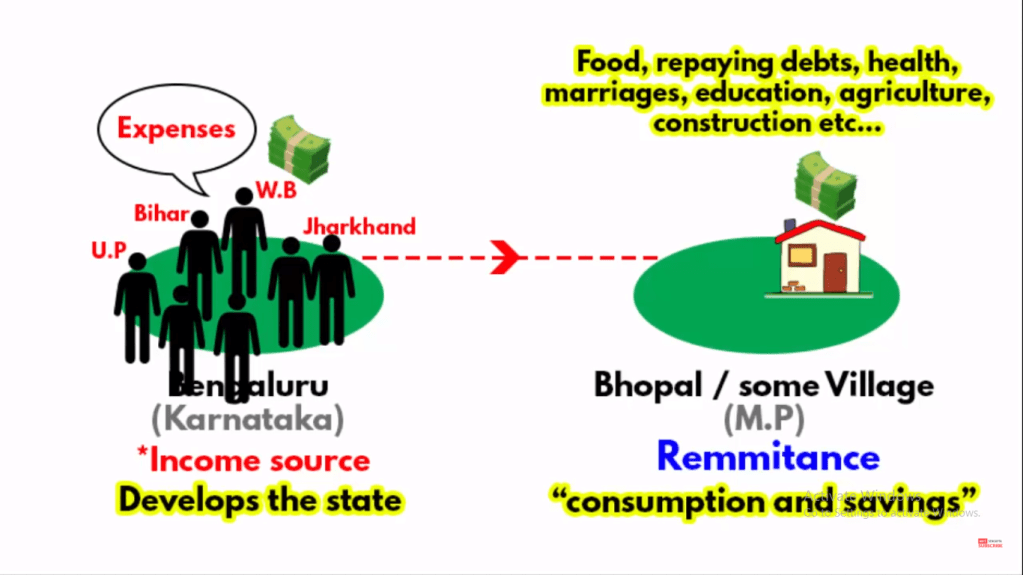
A person who is from UP and his/her livelihood is in Delhi. He/she earns some money and send it back to their Village. Some amount of this money that has been sent to the village is called Remittance. The amount of remittance is sent to their home plays a major role in economic growth.
Suppose, you are working in the city of Maharashtra and your family stays in Bhopal, so whatever you earn in Maharashtra, first you have to deduct your expenses as It is a high-cost city to live in, the you think of sending remittance to your home. Now, this money is mainly used for food, repaying debts, health, education, agriculture, marriages, construction etc. So when you send remittance to your home, then it is used for consumption and savings, and it plays a major role in economy. So, Maharashtra becomes the income source. If you notice, then Madhya pradesh’s economy is somehow driven by Maharashtra (income source area) in this example.
For Migrant workers source region like UP, jharkhand, bihar, orrisa, west bengal, MP etc, Remittance work as a life blood in their economy. Similarly, the opposite is also true, The income source area Maharashtra in this example also gets benefitted because many persons from these areas are coming here to work and that results into development of the state. As you have seen, migrant workers are important for both their home region and income source region in their economy.
But in this lockdown, many of the migrant workers faces problems, as a result they might find work closer to their home or in their home states that means it will put economic and infrastructural pressure in their home state and we know the state govt. of these states ( UP, Bihar, MP etc, basically the home region) can not do much because their finances are weak as the economy of these states are somehow driven by those big-cities, and now the workers come to their home, they don’t have any work but they have to eat, so their dependence on home-states agricultural sectors will rise. Now that is a serious problem, but if you look at the positive side then this is also a perfect time for these states to kick-start their MSMEs in the states and provide employment to these workers who have returned home. All these states can meet these challenges but for this , it will need all the support from govt. like tax benefits, aid, policies etc.
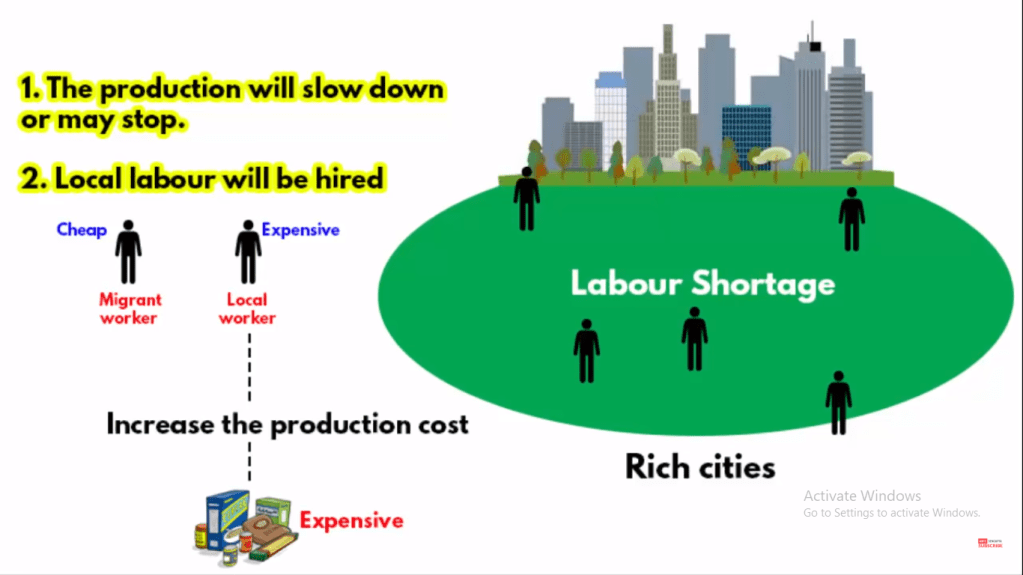
If we look the situation on the big-cities point of view then there will be a huge labour shortage in the companies, factories and local businesses due to which two hings can happen’
Production will slow down or may stop
Local labour will be hired.
Now, one of the important reason for these migrant workers to be hired is because their cost is cheap, The local labourers are not cheap due to which the cost of the product will increase. So, these are the economic importance of the migrant workers if they don’t come back. They are very important for us to run the economy.
I want to share one article with you by Harish Bijoor-
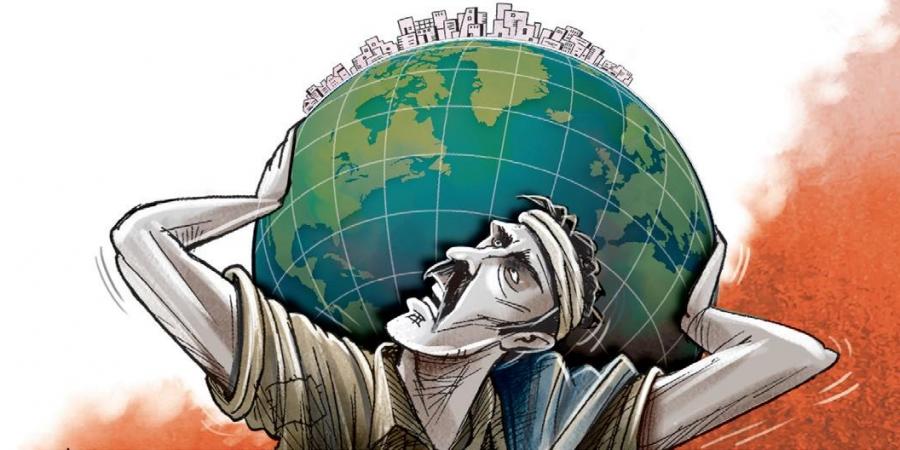
The migrant workers are the builders of modern India. Time to take care ofthem
I studied about the builders of modern India in history books at school. The names I still remember are many. Raja Ram Mohan Roy. Sardar Patel. Jawaharlal Nehru. J R D Tata. And not one mentioned the migrant labourer.
To me, the migrant labourer is the builder of not just modern India, but modern Singapore, modern Dubai and every modern country that prides itself on the glamour list of modernity.
In real and physical terms, there is no one to replace the hordes of migrant labourers who have sweated it out, putting together every edifice of everything from the Taj Mahal to the Trump Towers in place. Every office space we use, every home we now stay confined to, every club and every discotheque we have danced in, has been built by a migrant labourer.
The migrant worker is therefore a gig worker. I am sure they will baulk if they ever heard this snazzy but alien phrase to refer to them. But they will never ever hear it, or read this article for that matter, as they are distanced from it all. They are a part of society that is there and yet not there. In many ways they are a part of “Invisible India”.
India can be cleaved into two. “Visible India”, that belongs to most of us, and “Invisible India”, a part that is unrecognised, un-feted and dusted under the carpets most of the time, belonging to a host of 126 million migrant workers who work silently.
These are the folk who build that modern skyscraper and see it emerge from the dust, hollow-concrete brick by brick, and these are the folk who will not be there when that snazzy inaugural function declares the building open. Firstly, they are not invited. Secondly and more importantly, they just don’t have the time. They build and scoot to yet another site where they will build yet another edifice for modern India. Yet another edifice that means a daily wage and a livelihood.
126 million is nearly the population of Japan. Migrant workers as many as the population of Japan are forever on the move in India to keep the big city rolling. In many ways this is back-end India that offers the much-needed daily support to front-end India to keep the wheels of the modern economy moving.
They come in many avatars. There is a hierarchy even. There is the Uber and Ola driver who has migrated from Begusarai to Bengaluru. There is the mason, the carpenter, the food delivery boy, the painter, the plumber and many, many others. Let’s call them gig workers for now, who leave their villages in search of income to live a decent day and repatriate what remains to their families.
I will not be wrong if I add yet another population of 20 million, nearly as large as the population of Sri Lanka, to the population of the migrant worker. These would be second-generation migrants who now have settled themselves into the ecosystem of the city, living in the shanties and the slums, forming part of the support system of driver, maid, beauty parlour worker, car cleaner and security guard alike.
These people live on the periphery of visible existence. Most have left their identities back in their villages and don’t have one in their destination cities. Their vote is not mobile, and therefore they are non-participants, by and large, in the democratic process of the vote. Many live remote single lives, staying in touch with their families once a week through the small top-up prepaid mobile connection that is their lifeline with their roots.
The migrant labourer of India has largely remained a faceless entity till now. In comes Covid-19, and the plight of the gig worker at the rock bottom of the pyramid of prosperity is in public showcase. I think it is time for us to recognise “Invisible India” as part of the exciting “Visible India” we wish to boast of today and in the future.
It is important for us to take cognisance of every point of need—social, economic, political and psychological—that the migrant worker deserves. It is important for us to understand that front-end India would not be what it is today without them. It is important to appreciate as well, that they deserve a more equitable share of the spoils.
In closing, I must jump into my dengue mosquito analogy. Modern and prosperous India is all about living in the best of locales in gated enclaves. And just outside these gated enclaves, or very close to them, live all those who serve the needs, wants, desires and aspirations of those who live within those hallowed gates.
The gated-enclave mindset is to keep their homes and gated-enclaves clean and tidy. And they do, with the help of the support system that lives outside.The Aedes aegypti, which had us all scared during the last dengue outbreak, breeds in cesspools and locales that do not follow good hygiene. Many breed in the slums and shanties around our gated enclaves.
The mosquito bites those around in the slums and shanties and flies in gracefully through the gates of the enclave and bites all of us who belong to Visible India. It spreads the pain of the disease equally and does not know the difference between the “Visible Indian” and the “Invisible Indian”.
The blood of both tastes just as nice, I guess. If we don’t want to get dengue, we must take care of more than what we see and what we care about.
Time then for “Visible India” to take care of “Invisible India”. Not with the benign purpose of being good people alone. Not with the purpose of being charitable alone. But with selfish reasons as well. Touche!
A woman is the full circle. Within her is the power to create, nurture and transform
You are more powerful than you know, you are beautiful just as you are.
These are some of the quotes that we might have searched on google for writing content on women empowerment. Are these quotes really accepted in a country where 80% of population worships Goddess of different kinds(I am talking about India)? Do you know the conditions of women in India? Okay, let me aware you with some conditions based on facts and figures-
Here’s a list of some of the most horrific rape cases that have already been recorded in the first half of 2019.
A 16-year-old girl was gang raped for 5 days in Andhra Pradesh.
A 19-year-old girl from Bihar was allegedly gang-raped by 6 men in front of her father.
A 12-year-old Dalit girl was allegedly raped and then beheaded by her 3 brothers and uncle in Madhya Pradesh’s Sagar district.
A 4-year-old girl was raped in Aligarh after the accused lured her with ₹10 note and took her to a secluded spot.
A 11-year-old girl was raped and murdered in Unnao and her body was found lying in an orchard.
A 3-year-old girl was allegedly raped by her 11-year-old neighbour in Dehradun when the girl’s parents were not at home.
A 13-year-old girl was raped by 2 men at her home in Shahjahanpur when her parents had gone out to purchase medicines.
A 9-month-old girl was raped in Telangana after the man took her to a secluded place in the wee hours.
A 4-year-old girl was raped in a private school in Punjab.
A 17-year-old deaf and dumb girl was allegedly raped by 3 men in Rampur who also filmed the act.
A 16-year-old girl was kidnapped, confined and raped by 3 men in Noida for 51 days.
A 6-year-old girl was raped and murdered by a drunk teenager in a Hyderabad village after she went missing while playing Holi.
A 7-year-old girl was raped and murdered in Kannauj after being abducted from a temple near her house.
A woman was repeatedly gang-raped at a farm house in Ludhiana after she and her husband were abducted, looted and beaten up.
A 4-year-old girl was raped and murdered after being kidnapped from a slum in Indore.
Are you angry?? wait wait.. Let me give you some more content.
The share of female enrolled in higher education in India was just over 23 percent in financial year 2015. There was an increase in the number of female students enrolled in higher education institutes across India since the passing of the Right to Education Act in 2009. However, this does not consider that many female students, especially in rural areas, drop out of school before even completing their elementary education. The root cause for the decline in the number of educated women in India was attributed to gender inequality lying at the core of social norms and the education system.
the average life expectancy of women at birth in India was about 70.43 years.
In 2019, it is projected that the average share of women in parliaments around the world stood at 24.3 percent, up from 13.3 percent in 2000. India ranks 20th from the bottom in terms of representation of women in Parliament.
The highest employability among female graduates was in the retail sector with 50 percent, and lowest in the manufacturing and oil/gas power sectors with nine percent each during the measured time period.
A youth survey conducted among 15-34 year olds across 19 states across India in 2016 about their attitude towards women working after marriage. About 20 percent of respondents agreed that it was not right for women to work after marriage, while a majority of young adults disagreed with this statement during the survey period.
440,000 entries of cases that have been reported since 2008.
The wage gap between Indian men and women is amongst the worst in the world, a report by international confederation of charitable organisations, Oxfam, said. The Monster salary Index (MSI) says, Indian men earn 25% more than women in the same kind of work done by both men and women. The average gender gap is 38.2%. However, Accenture research says that the gender gap in India is as high as 67%. More than 47% of women in India are involved in Agriculture related works, however the wage gap is beyond comprehension, because of non-uniformity in sectors, which is the same for other unorganized sectors in India.
Women’s participation in the force is quite low, and has been falling over the last few years. The female to male ratio is only 0.36
Given to India’s patriarchal nature, domestic violence remains as culturally accepted because of cultural and religious reasons. In a survey with young men and women in India, 57% of boys and 53% girls accept women beating by husbands is justified. In another recent survey between 2015-2016, it revealed, 80% of working women suffer domestic violence at the hands of their husbands
India is ranked 105 amongst 128 countries in its Education for All Development Index. Among SAARC nations, India stands third behind Sri Lanka, and Maldives. India still has one of the lowest female literacy rate in Asia. As per the India’s last census in 2011, the female literacy stands at 65.46% compared to 82.14% of males. estimates show that for every 100 girls in rural India only a single one reaches class 12 and almost 40% of girls leave school even before reaching the fifth standard.
India reports 104 rape cases daily in which 40% rape victims are minor.
According to the survey on 2018 by Thomas Reuters Foundation, India is world’s most dangerous country for women. Thomas Reuters is world’s biggest network based in canada. Its main focus is on journalism about women’s right, climate change and child trafficking and they carry out their researches on these subjects. This particular survey ” world’s most dangerous country for women” according to them is a perception poll and it’s not based on any data or poll. This is based on perception of not any local individual but of experts i.e. How the experts feel about a country, what is their opinion, perception about it. One thing to keep in mind that if we ask perception of a commoner then it is based on his surroundings, experience, but if you ask an expert about the perception then it’s of a very higher value as an expert is working in that field, researching on facts everyday about it and that creates a difference so as his perceptions and opinions are generally based on facts.
So total of 548 experts were surveyed out of which 41 were from India and they answered questions for ranking based on different categories like sexual violence, human trafficking, non sexual violence, human cells etc. based on these categories , they had given the final ranking of the world’s most dangerous country for women. So based on these experts perception, India is ranking no. 1 in 2018 amongst 192 countries. #2- Afghanistan #3- Syria #4- Somalia #5- saudi Arebia ,#6- Pakistan.
This survey based on perception was done in 2011, that time India’s rank was 4.
If we breakdown these categories then India was ranking #1 at Sexual violence, Human trafficking , culture and religion against women ( child marriage, acid attack etc.) , #3 at discrimination which includes discrimination against women in the daily life like in education, in job etc. , #3 for non- sex violence and #4 at health across.
Now the question is how credible and truthful is this. Talking about credibility, Thomas Reuters is a very credible organisation which won many awards like Asian Environmental Journalism Award in 2015 for excellent environmental reporting, it also recieved United Nations Foundation Prize etc. This organization providing training to journalist in more than 170 countries.
There is a question arise, Why is there a perception based survey and why not the reports are based on data and statistics? When it comes to crime data, then stats and data don’t make sense. e.g. Kerala has the highest crime rate in comparison to other states but that does not mean when you go there, you find violence. Infact it’s the highest because people are reporting these cases and hence kerala comes under one of the safest states. The same thing applies on other countries also. If you compare crime rates based on facts and stats, then you would not find the actual crime rate.
If you look European countries like sweden, Botswana, then the crime rate of women is highest but that does not mean these are the dangerous country for women, Infact it is the opposite as people are reporting here. We will never find actual cases as many of the cases are not reported or written anywhere.
That’s why, taking expert decision into account is a good idea.
In 2017, Indian National Bar Association took a survey of 6047 women and realised that 70% of Indian Women are afraid of registering their sexual harassment cases. So here you can find how many women are afraid and there will be many cases which would have been denied by police.
So basically it cant be said that India deserve 100% to be on rank 1 or not because these experts also has some limitaitons which people have pointed out. Like its not been revealed which field does these expert belongs to and what are their qualifications? So its not so transparent. But apart from limitations if we consider facts, then if not rank 1 but it lies between 1 to 10 by looking at current scenarios.
e.g. Female foeticide which is related criteria on the basis of which this consensus could be drawn then India is no. 4 worst country in 2016. This can be found out by looking at the sex ratio at birth. which is 112 males to 100 females.
Other countries- 106:100 (Syria), 104:100(afghanistan), 102:100 (somania).
Top 3 countries that rank worst than India in birth sex ratio are Leichtenstein, china and Armenia but these counties don’t have those problems like Crime against women and all that’s why India’s rank goes to the highest point.
Dowry related death: According to National crime Bureau, every year more than 8000 women dies due to dowry in India.
But many people like the one who was trying to find nano chip in our 2000 rupees note, sudhir chaudhary said that anti- India agenda has been started by this organization but if we see the tweet of PM Narendra modi of 2 oct 2013, then he wrote ” India is considered 4th most dangerous for women, and this was based on the same survey, considering the fact that many of the persons at that time was complaining but now, because Mr. Narendra modi came into power they call it anti-India agenda. The same thing was written by BJP’s MP Rajiv Chandrasekhar in 2014 and Amit Malviya in 2013, and now in 2018, they opposed it fully.
As we can see, for the first time we are witnessing rally against a rapist, religion has been interfered in rape case (kathua rape case).
Some more reasons– Psychologist Madhumita pandey has interviewed 122 rapists in Tihar jail in 2013 to know why they rape?. In her interviews she said, most of the convicted rapists presented themselves as nonrepentant and attempted to justify their crimes.
According to Mukesh Kumar, convicted on Nirbhaya case, said A decent girl won’t roam around 9o’ clock at night. A girl is far responsible for rape than men. You can also see speeches on Asaram Bapu on Nirbhaya case.
Believe it or not, there are many bollywood songs and scenes which should not be used. Even Australian man accused of stalking escapes conviction after blaming Bollywood according to THE TELEGRAPH.
Solutions- – Accept the problem—First step to solve any problem is to accept the fact that the problem exists as our government has denied that report.
Thompsons Reuters organization’s CEO has given the solution in three words- EDUCATION, EMPOWERMENT, ENFORCEMENT.
In Nairobi, Kenya, every four girl (25%) had been through sexual assault , so they ran No means No campaign classes to the students which resulted in 40% decrease in rapes.
Now, I am looking for you to provide some suggestions and ideas in the comments to be implemented to curb this problem..
Are you tired of your job? Do you want to get extra income as your part-time job? As a student do you want to earn money for your education? Are you really good at something and want to show your talent to the whole world?? I think most of you will answer, “yes”, So how could you do this? There is one way, which is YouTube.. yes, you can earn money from YouTube.. But how??? Are you aware of the process how a YouTuber make money?? No???? Let me help you..
YouTube is a video sharing platform owned by google, which allows anyone to make videos, whether it be on cartoon videos, animation videos, bloggings, or your daily activities, there are viewer on one side who view videos and YouTuber on other side who create videos.. so, how YouTuber get money? YouTube doesn’t give money from it’s pocket, there are many companies who want to put advertisement in the YouTube for their products or services, so they pay money to YouTube and YouTube put their ad to the videos, the earning of YouTube in all these scenario is 45% and rest of the 55% will go to YouTuber… e.g. If I pay Rs 200 to YouTube for my ad then it will keep rs.90 with them and rest of the amount with the creator. This is the first way to earn money
2nd way is the sponsorship.. In the 1st way , we talked about the YouTube getting 45% of the money , but here company will directly contact to the YouTuber and ask him/her for the price they wanted. After the settlement, they get sponsored. In this way, company save their lots of money as well as YouTuber also get good amount in sponsorship. You may heard in many videos ,this video is sponsored by or Powered by….
3rd way is affiliate marketing.. Affiliate marketing is the process by which an affiliate earns a commission for marketing another person’s or company’s products . Many online shopping websites like amazon, flipkart etc who are doing this. The affiliate simply searches for a product they enjoy, then promotes that product and earns a piece of the profit from each sale they make. The sales are tracked via affiliate links from one website to another.
You can visit this website to get idea about the amazon affiliate commission:
4th way is from buying membership of the channel.. You might heard from many youtubers to join the channel, so that we will be provided with extra benefits like superchat, livechat etc. through which they directly earn money.
5th one is from merchandise, It is the activity of promoting sales of goods and services. You might have heard from many youtubers, promoting and selling the products like cap. keychain , t-shirt etc. e.g. Suppose I am a youtubers and I urges my audiences to buy the product and for this, i will be given some %age as a comission. Many youtuber promote it by printing the logo on t-shirts and other ways also.
So, these are some of the methods through which a youtuber earns money and youtuber will only get money through views, it does not depend on subscriber, and in the views, if the ads will be watched then only they get money from youtube, otherwise NO.
Always focus on content. Through content you definitely get views and after that sponsorship, affiliate marketing etc., different methods are there through which you can earn money………………………………………..
Have you ever searched on google, what is the per capita income of India in 2019-20? I think you must have aware about it? It is Rs. 11,254 per month, i.e. Rs. 1,35,048 per year, and Goa has the largest per capita income with around 4,30,000 per year and one state with per capita income of 43,000 only. Yes, 43000 only.. You can see the difference, there is gap of Rs.3,87,000. At one side of India, a person is getting Rs. 35,840 per month and on the other side, a person is getting Rs. 3,584. There is a 10 times difference between these two states. The state I am talking about is Bihar. Bihar has a literacy rate of only around 64% (lowest in India) which is below the nation- average literacy rate i.e. 74%. We have different questions in our mind, and we will get all these answers but before that get some facts about Bihar:
The renowned Mathematician, Aryabhatta hailed from Bihar
Some of India’s greatest emperors belong to the state of Bihar namely Ashoka, Vikramaditya and chandragupta
Shri Rajendra Prasad, India’s first president of India was born in Bihar
Nalanda, World’s oldest University, which attracted students from all over the world in ancient times.
Lord Mahavira, the last jain tirthankara was born in Bihar
Munger, India’s oldest city producing guns since 1800s
Bihar is the state which is considered as the second most IAS producing factory.
Bihar is the birthplace of tenth Guru that is Guru Gobind Singh and the holy place of Sikhs is Harmandir Takht which is in Patna.
Most of the Bihari people are considered highly intellectual in Mathematics
Patna has the world’s longest Wi-Fi range of 20kms which is in Bihar.
Bihar plains are among the most fertile plains of the world. Formed by mighty rivers like Ganga, Koshi and Gandak.
Nalanda library was so huge that it kept on burning for three months and it destroying nine million manuscripts.
In 1960, according to NSDP, the lowest per capita income was on Bihar and In 2020, the same condition is there.
According to multi- dimensional poverty Index, the values of UP and Bihar is same as Congo and Malawi, which are poor african countries.
There are many historical problems are responsible for this:
a) Unequal land distribution- Permanent settlement act was introduced by Lord Cornwallis in 1793. At that time, Britishers source of income from farmers of UP and Bihar was from tax. There were three main ways to collect tax:-
Zamindari system
Ryotwari system
Mahalwari system
Zamindari system was there in provinces of Bengal, Bihar, Orissa and Varanasi. Zamindars were recognized as owner of the lands. Zamindars were given the rights to collect the rent from the peasants. Because the agriculture output was falling, the tax collected by Britishers was also low, thats why in 1793, britishers fixed the tax for each zamindar. That’s why the peasants had to give the fixed tax, drought, flood etc did not matter, anyhow they had to pay fixed tax. This often led to the land of peasants being taken away, creating rural caste- class conflict. Researchers also found that “With the mounting frustration of peasants, more and more areas came under the hold of the Naxalbari type movement.
In the provinces like Bombay and Madras, the tax was not fixed, they were paying taxes according to the agricultural output.
The zamindari system was abolished in 1947. But its negative impact continues in UP and Bihar. To prove it, Nobel peace prize winner Abhijit benerjee and Lakshmi Iyer compared the states in which zamindari system was imposed and not imposed. There they found that:
States with Zamindari system in 1870s and 1880s led to
Lower agricultural yields in 1960
Lower literacy rates in 1980s
Higher infant mortality in 1990s
More crimes like murder, kidnapping, rapes in 1990s
b) Lack of investment in agriculture:– In 2002-03, 33% of households in Bihar was landless and 15% of the households had less than 400 m sq. of land. This means that most of the lands was with zamindars, and those who work on land have no money to invest and those who have money, no reason to invest. And most of the people migrates also therefore there is little investment on agriculture sector. Apart from private investment, there has been very little public investment in agriculture.
% of land irrigated
Bihar- 50%
UP- 60%
Gujarat- 87%
Punjab- 90%
In 1980s , many farmers in Bihar and UP started using ground water but it did not lead to a rise in productivity because
Electricity supply was inconsistent
Prices of diesel, petrol, fertilizers increased but the prices of harvest did not increased.
While other states could provide subsidies to their farmers but UP and Bihar could not.
The small landholdings of UP and Bihar farmers make it difficult for them to sell at govt. mandis because their transportation cost could be higher than the price . They might not get profit.
The agricultural sector is vital for UP and Bihar because of :
Heavy dependence on agriculture as the contribution of agriculture sector in India is around 20% but for the Bihar , it is double
Presence of fertile land due to Ganga passing through the two states.
2. Freight equalization policy– India’s government FEP of 1953 removed Bihar’s mineral wealth advantage. FEP was aimed at promoting equitable industrial development by subsidising long-distance freight transportation. It may be worth noting that FEP applied only to certain commodities such as iron, steel, cement, which were deemed essential for the economy but did not apply to raw materials like cotton. Hence, the states such as Maharashtra and Gujarat, which benefited from the FEP, also maintained their hegemony of raw materials such as cotton. While the manufacturing industries started moving west and south, eastern India didn’t get an opportunity to set up cotton and textile mills as cotton was not subsidised under this scheme.
The states of West Bengal and Bihar (including the part that is now Jharkhand) in 1950 accounted for 92% of the country’s steel production and 48% of all manufacturing. The states were rich also in coal and other natural resources. At that point in time, only two integrated steel plants (ISP) existed in India: one at Jamshedpur, Bihar, and the other at Burnpur, West Bengal. However, the Planning Commission decided also to provide subsidies on freight transportation to industries anywhere in India, thus negating the advantage a manufacturing industry would have if they were located closer to the steel plant. Bihar’s Industrial sector got effected due to this policy.
The policy was changed in 1991, but it has had a lasting impact on Bihar’s economy.
e.g. Private investment in 1995 in Bihar was 2.68% while on other 14 major states, it was 16.45%
The lack of Industrial sector , puts a lot of pressure on the agriculture sector in UP and Bihar. From 1971 to 2001, the % of people working in agriculture in India got low but in Bihar, it was high. But due to lack of growth in the agriculture sector , people had to migrate.
UP and Bihar has highest migration rate in country according to ASSOCHAM
3.Cast- Based politics: Post- independence , high-caste elites had power in UP and Bihar, after 1970s weaker sections of the society started organizing themselves like samajwadi party, janta dal etc. But the political mobilisation has not improved the economic prospects of UP and Bihar. Bihar had also suffered from political instability for decades, e.g. From 1961 to 1990, Bihar saw 20 government , none of which completed their terms (which means govt. was more focussed on their politics, not in making reforms)
4. Lack of funds from the centre– From 1951 to 2012, Bihar recieved the lowest developement funds on the basis of per capita while other states like Maharashtra, Harayana, Gujarat got doubled fund. The fund that Bihar got was less than half of the national average. Lack of funds could meant that the states could not invest in education , health, agriculture or the industrial sector, and one more reason was that government was so unstable and incapable in administration that they were not able to collect tax in a proper way. They were also unable to use the money they were given (through tax and other forms). We can also see that In the 8th and 9th plan, Bihar’s utilization rate of their developement funds was only 50%. This shows the incapability of administration.
British govt also had not given importance in the state of Bihar as the expenditure that they made in 1876 and 1927 was very low for general administration, education and health sector. Citing the original 1930 report, while there was one police officer for every 776 individuals in Bombay presidency, in Bihar there was one police for every 2,372 individuals.
There are some of the other reasons also:
1. Geographical Disadvantage: As Bihar is a landlocked state and there is no international geographical location like Gujarat, Maharashtra, Karnataka , Kerala, Tamil Nadu which have more opportunities to go for international business. But Bihar has to pay more transportation cost and all, and it also has drought ridden area as well as flood hit area which forces people to migrate .
2. No major industry: There was no major industry in Bihar, the situation became worse when jharkhand was separated from Bihar, most of the minerals, corporates, minings, Bokaro steel city, tatanagar jamshedpur that all got seperated from Bihar.
3. Frog in the pond think it’s An ocean: Most of the students from Bihar only wanted to become IAS/IPS officer due to which , they are not focussing more on entrepreneurship.
4. Higher fertility rate: Fertility rate of Mother in Bihar is high, due to which the population get increases.
What are the solutions that should be taken:-
1. Increase land security through land redistribution or other reforms. Increasing security of land would make people invest more in their land. The govt also digitise land records and speed up land cases.
2. Greater support from the central government.
3. Make states industry- friendly by improving investment climate and law & order.
4. Use Bihar diaspora working in other states and countries.
5. Bihar has youngest population and hardworking person in India , so they should focus more on making their state proud through entrepreneurship like Anil agarwal ( founder and chairman of vedanta Resources plc., Ravindra kumar sinha, founder of SIS security etc.)
Nitish Kumar is hailed as a leader who has bought attention to Bihar’s development. Bihar’s growth rate has increased under Nitish kumar-
Between 1993- 94 and 2005-06, it was 4.8% and Between 2005-06 to 2011-12 , it was 13.5%.
Bihar has significantly reduced poverty over the last few years but need to improve much more………..
First lets look the definition of stock market- The stock market refers to the collection of markets and exchanges where regular activities of buying, selling, and issuance of shares of publicly-held companies take place. Did not understand? Okay let me brief you through example: I am a person who regulary buy vegetables or fruits for our own use but in share market, we buy shares in virtual form where we get some partnership on the company (according to the no. of shares. So, why people invest in share market? Definitely to get profit. It is also true that we get high profit in share market than other options available like savings, Fixed deposits , government bonds etc. But, as we can get high return, so the risk is also high. We may loose our money if we invest carelessly, Perfect example is 2008 crisis, you may go through it.
Now, i am only going to brief you about the stock market , after that it is better you to decide whether you want to invest or not?
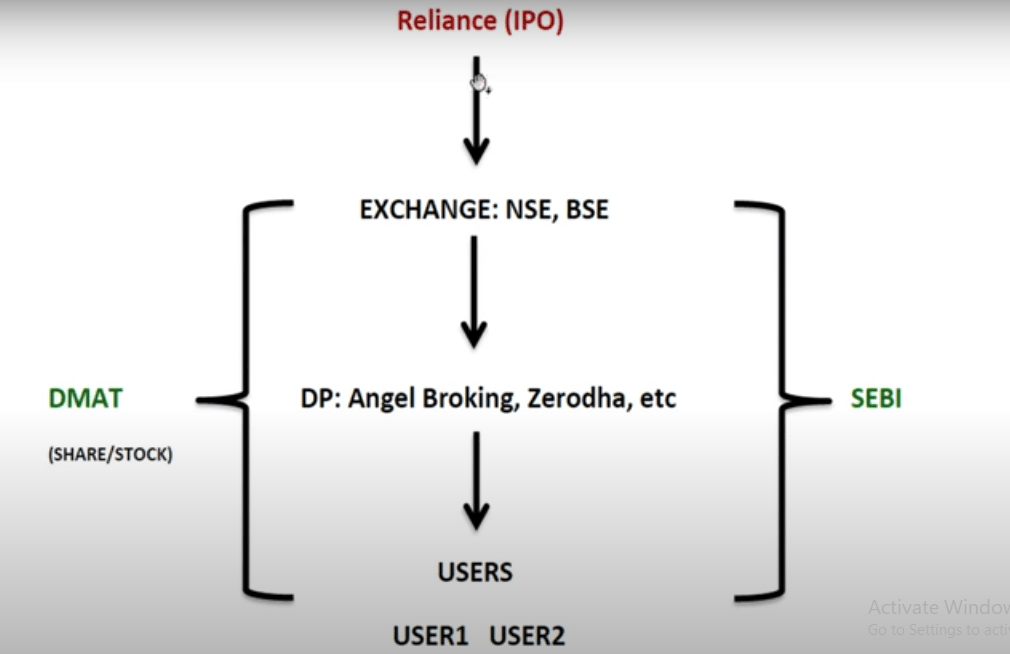
Now, this is the process of how share market works. Suppose I am reliance and I need money, so i will launch IPO (initial public offering which means the company is offering its shares for sale to the public for the first time.) I want to introduce 10000 shares of my company, then first i have to go to SEBI ( which regulates all the processes right from beginning to end) and have to verify all my documents and have to get approval. After getting approval , i will approach stocks, BSE and NSE, which will help me to get capital for my shares. Now, there is a term called DP (Depository Participant) like Angel broking, zerodha etc. There are more than 15000 registered DP is there. It is a platform which deals with the users to invest their money . It helps investors to buy or sell stocks.
Now, the question comes, how DP deals with the users?
So, here Demat and trading accounts, play the role. Demat Account is an account that is used to hold shares in electronic format. During online trading, shares are bought and held in a Demat account. It is controlled by government under CDSL and NDSL. Now, after reliance will get capital, he does not have any role in the scene. So, there are three accounts that we need to do all these transaction, savings account( when you want to withdraw money), trading account( through which we will trade) and demat account. Now, DP opens the demat account and trading account. So, these all are the hierarchies that we need to know before investing.
So, why all these companies, exchange and DP are doing this? what are their benefits in this point? we might loose our money but all these companies, DP, SEBI, exchange, they will surely get their money with 0 risk in the form of taxes and brokerage.
Now, lets see, where, how, when , what we should invest?
Equity: Equity is the shares which we buy or sell. There are two types of equity
Delivery: When you buy share and want to keep it in your demat account, , may be for long period of time. Its upto you (you can sell share except on the same day when you buy).
Intradey: Intradey is the same day selling and buying process. you cannot keep it with yourself. If you would not sell it, then it automatically be sold at the end of the day ( which is called square off)
MY OPINION IS TO INVEST IN DELIVERY
There are other options are also available:
F&O, Future and option which is an assumption that which share price will go high or low ( watch the movie Bazaar)
commodity like gold, petrol, diesel, natural gas, silver etc which you can buy or sell virtually
Currency ( currency of different countries like dollars, singapore dollars etc.)
But i will suggest only Delivery and we will talk only about it.
Now, how we calculate maket is up or down?
Here SENSEX and NIFTY will play the role. SENSEX and NIFTY are the top 30 and 50 companies respectively which forces market price.
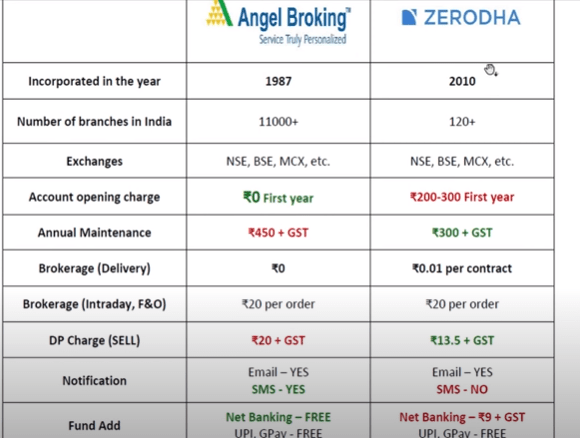
Now, how the DP gets their money:
This is how, DP makes their money as we can see above.
You need to provide your aadhar card, pan card etc. as your document. In some DPs , you can use digilocker also.
Where to invest? how to invest? you will get all these answers , when you start working on it.
There is a concept called stop loss.
For example, let’s say that you bought 200 shares of a company ABC at Rs 100. However, you do not want to lose more than 5% of your money, in case the trade didn’t work out as expected because of any reason. Here, you can put a stop loss to automatically sell your shares if its price falls below Rs 95.
Therefore, by putting a stop loss, you are limiting your losses. You are booking a loss at 5% and avoiding the scenario in case the trade might turn out ‘sour’ and the share price falls more than 5% (say 7 or 10%).
Choose a company which has a good past record and it also depends on the type of companies which has a good startup ideas( like ola, oyo etc.). You can visit moneycontrol.com where you will get all the details about the companies (balance sheet, records etc)
How all the companies and these segments make money
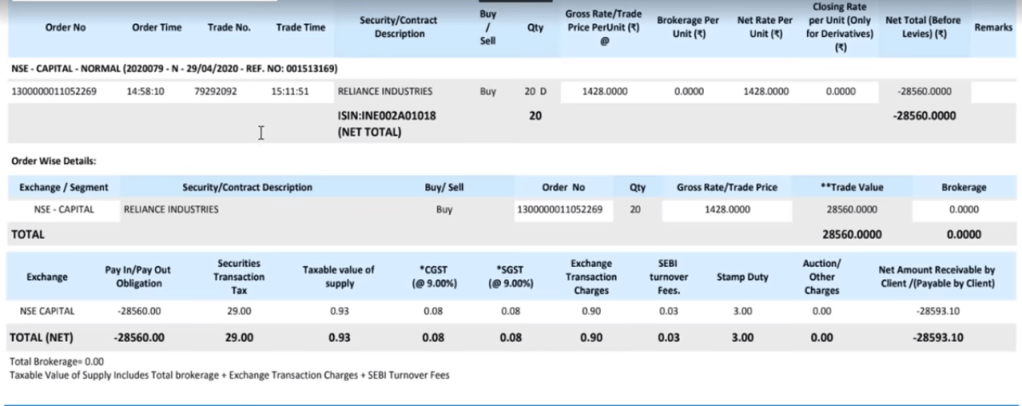
At the end of the day (after you done your buying and selling process) , you will recieve a contract note in which you can see all of your taxes that is levied.
we can assume that, In an investment of 1 lakh, you have to pay 300-350 *(approx) as your taxes and brokerage.
After that you also need to pay income tax in it. If you buy delivery and within 1 year, if you make a profit (through buying and selling) then you have to pay 15% flat tax. eg. If you buy a share in delivery and you sell it in 15-20 days and you got a profit of Rs. 1000 then you need to pay 15% of your profit.
Second one is long term capital gain, In these scenario, if you buy a share and sell it after 1 year then you will be charged 10% tax only if you make a profit of more than Rs. 1 lakh, otherwise you will not have to pay taxes.
But if you trade in intradey, and you get a profit of ‘X’ amount then you will have to pay tax according to the slab decided by government ( during the budget).
After you open your demat account, you will recieve a message from CDSL where you can create your own login details under CDSL. As you can fet your information from DPs also, but if the DP get fraudlent then you can also see your all details under CDSL Login details.
This was just a basic about stock market which you can refer while opting for stock market. There are many concepts to learn about stock market which you would get while trading.
Last blog, we discussed about Barcode where only alphanumeric value can be stored. But we have advanced technology named QR CODE where we can store information that we want. There are lot of questions arises when we see QR code. For instance: 1) How QR code works? 2) Can we create QR code? 3) In which ways it helps? 4) Why QR code is important and all companies are using it as a medium?
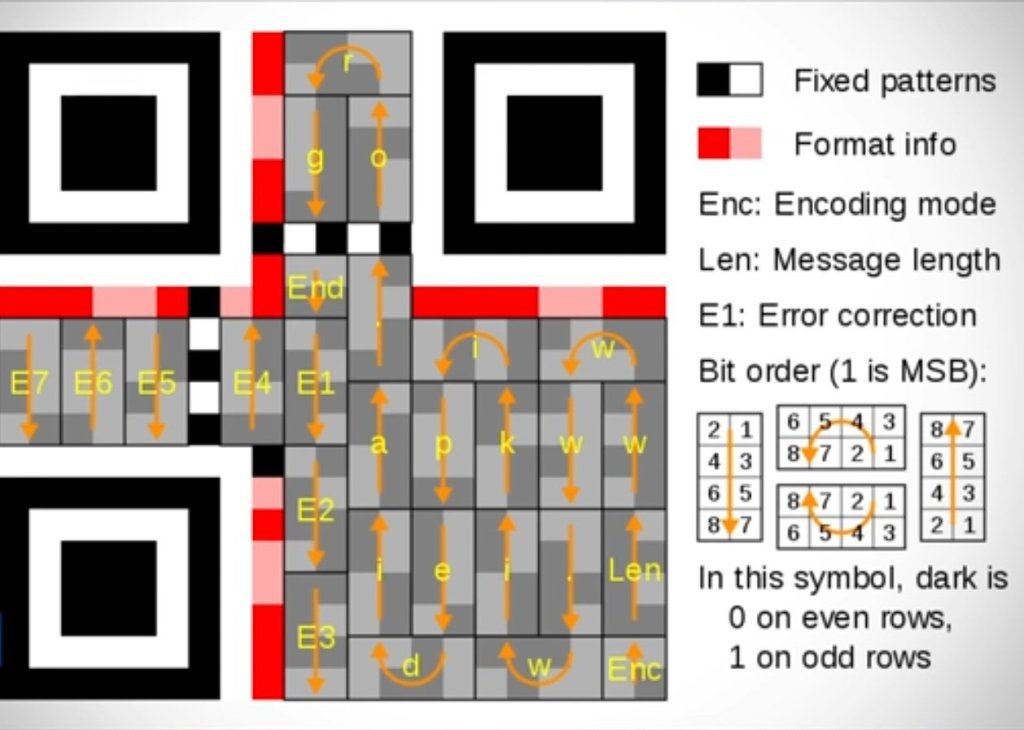
There are lot of questions to answer and we will be able to answer most of the questions written above. QR ( Quick Response ) code is used to take a piece of information from a transitory media and put it in to your cell phone. It can store (and digitally present) much more data, including url links, geo coordinates, and text. Is this enough to know about this technology or do we need to know more? Definitely more.
QR code is only used to store data in any forms we want which can not be seen through eyes but it needs scanner or smartphones to collect that data. As we know that most of the companies are now accepting this technology like paytm, whatsapp, BHIM etc. because it helps them to store more and more data & information. It also helps people to avoid mistakes. For instance, In earlier times, people used to type any link in their phones or desktops manually and if any spelling mistakes would happened then he/ she might landed up in any other page. But things are changed now, whenever we make online transactions, we scan QR code rather than typing number to make payment ( to avoid typing mistakes). QR code are a common sight now. Thanks to the increase in smartphone penetration that went from 10% in 2014 to 36% in 2018. And access to high-speed mobile internet which increased from 48.8% in 2014 to 61.2% in 2018.Nearly half of all smartphone users have used their phones while shopping in brick-and-mortar stores – 40% of them to compare the competition’s prices .Statistics for who’s scanning QR codes and with what device appear to be mixed, although most data places iPhone users at the top, with the user age range being 25-34. Japan and the U.S. are currently leaps and bounds ahead of other countries in QR code scans (around 60% approximately) – with Canada and the U.K. trailing dozens of percentage points behind. How exactly QR code looks like?
Most of the business are using QR code.
Now, can we create QR code? Definitely yes. How?
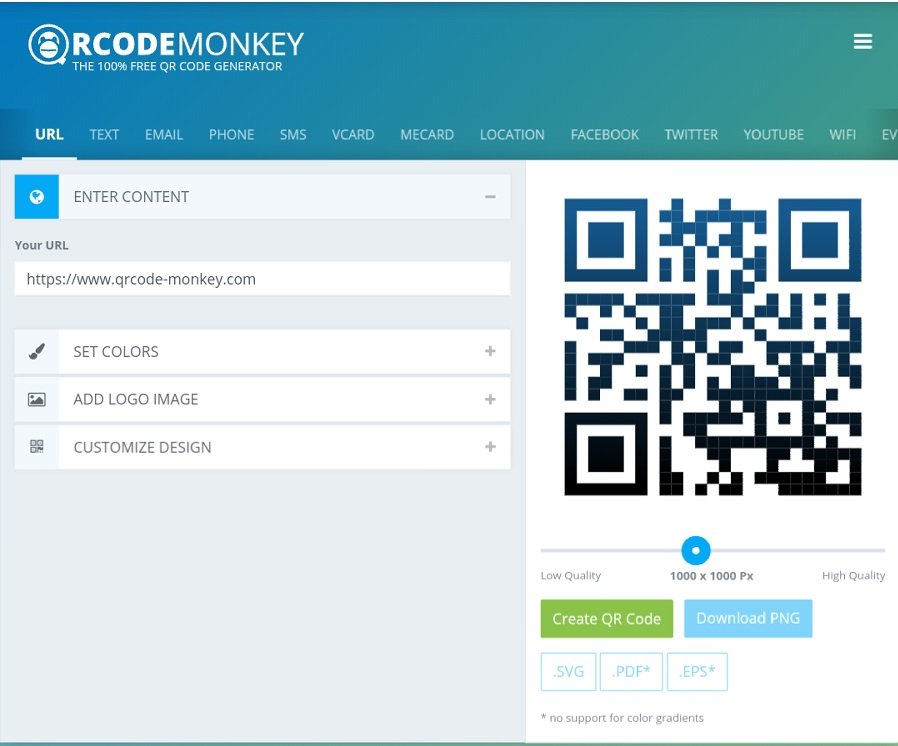
When you search on google QR Code generator, you will find many websites through which you can generate it. But in my opinion go to QRcodemonkey which is a free QR code generator where you can store your information in the form of url, text, email etc.
Here, you can customize your QR code in many ways by applying many colours and design into it. After clicking on create QR code, a QR code will created and then you can use it in many ways.
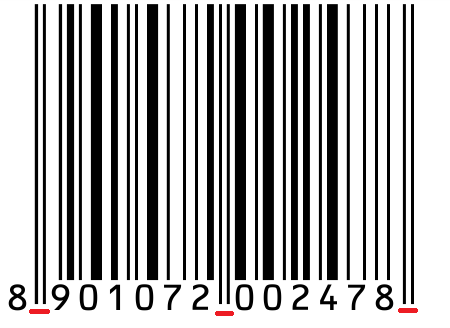
I think you must know that every product which you have in your home have a barcode. So what this barcode is all about? Why we check barcode in every product that we buy? Why every barcode starts with 890 ? why company are paying lakhs of rupees for each barcode? There are a lot of question to arise and we will be able to clear all questions at the end of the blog.
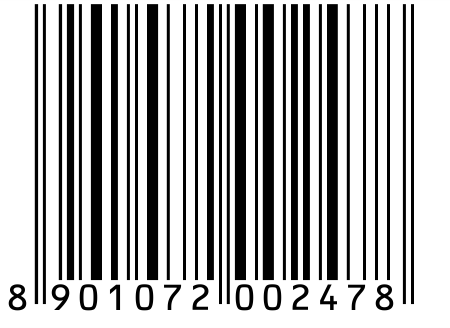
A machine-readable code in the form of numbers and a pattern of parallel lines of varying widths, printed on a commodity and used especially for stock control. This is the general definition of barcode but is it enough to know? No. Definitely we need to learn more about it. So some facts are as follows:
A normal barcode has 95 lines consists of black and white parallel line where first three, central three and last three lines looks like below.
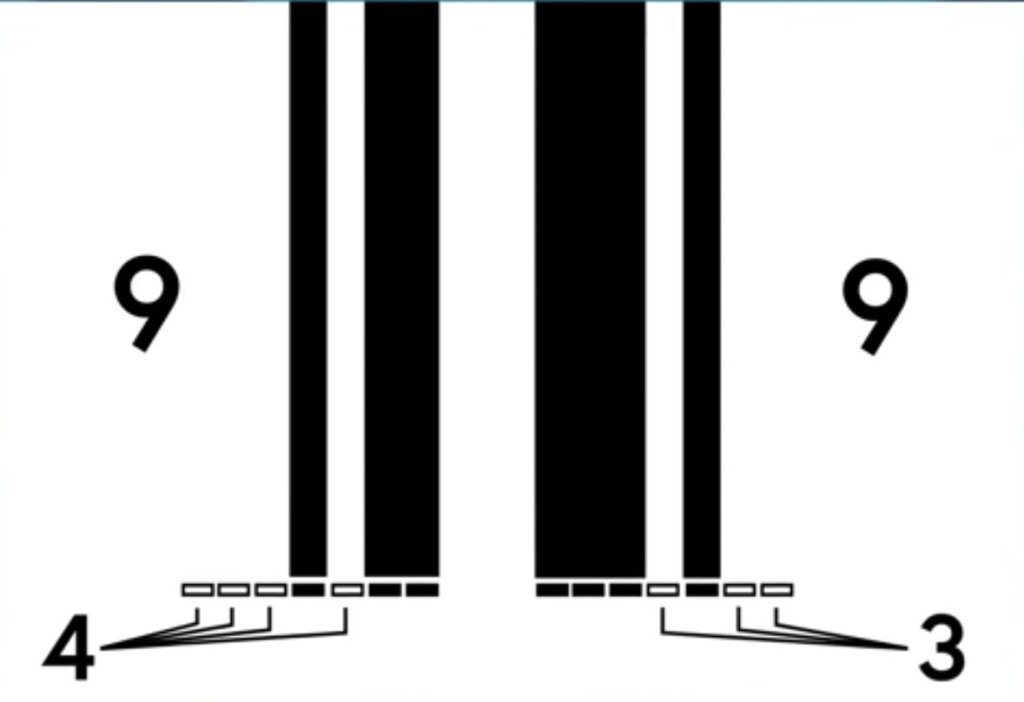
The no. of lines that is right and left to the centre is 42 each. In these 84 lines, every 7 lines consists of one block consists of one number. Every block (7 lines) consisting of single no. are different in width (black and white) of right and left. Same no. allocated to each block in both sides does not have same width.
Number on the left side have even no. of wide space and no. on the right side have odd no. of wide space which helps the barcode reader to know from which side it should read as many a times the handling of the product might be opposite which leads to make the machine to read from left instead of right.
For instance,
if the machine reads wide space ‘even’ then it have to scan from left to right and if the machine reads wide space ‘odd’ then it have to scan from right to left.
These all comes under technology and that technology was made by a company named GS1 ( Global Standard 1) which is a type of non profit organization made a standard for every company and it also alloted different series to different countries. For instance, if you see barcode of USA ,then it starts from the range 1 to 19 and if you see In India, it starts from 890 and the format of the barcode is country’s code then company code then product code. GS1 makes money by providing barcodes to different companies for their products. Now if we want to know which barcode is allotted to which company then you should go to this link
Here you will find all the details of the barcode.
If that barcode is not started with 890 then it is definitely made for special authorities, otherwise you have to purchase barcode if you want to sell your products.
Now, most important question. Why to use barcode?
In earlier times, inventory management was difficult because of the confusion regarding details and all but barcode makes the work easier and it helps the companies to keep full details with proper management.
After this, there is one more technology in similar lines which is QR Code. We will discuss it on next blog.
Do we really need to know about the epidemic COVID 19? The condition that the whole world is facing now a days left us with many questions. We also need to be clear about this epidemic or We also need to arise some questions:
1) Why US has seen more no. of cases than any other country?
2) Why China has recovered more than 93% of cases as on March 31?
3) Why Italy has seen most no. of deaths?
4) What is the rate at which it spreads?
5) Does lockdown would be helpful for the country?
6) What is the global impact of this epidemic?
7) Which sector would mostly get effected and which sector would be benefitted?
8) What would be the condition of our economy afterwards?
9) What are the different relief package that the countries are providing?
10) When its vaccine will be introduced ?
11) How people are getting recovered if the vaccine is not introduced?
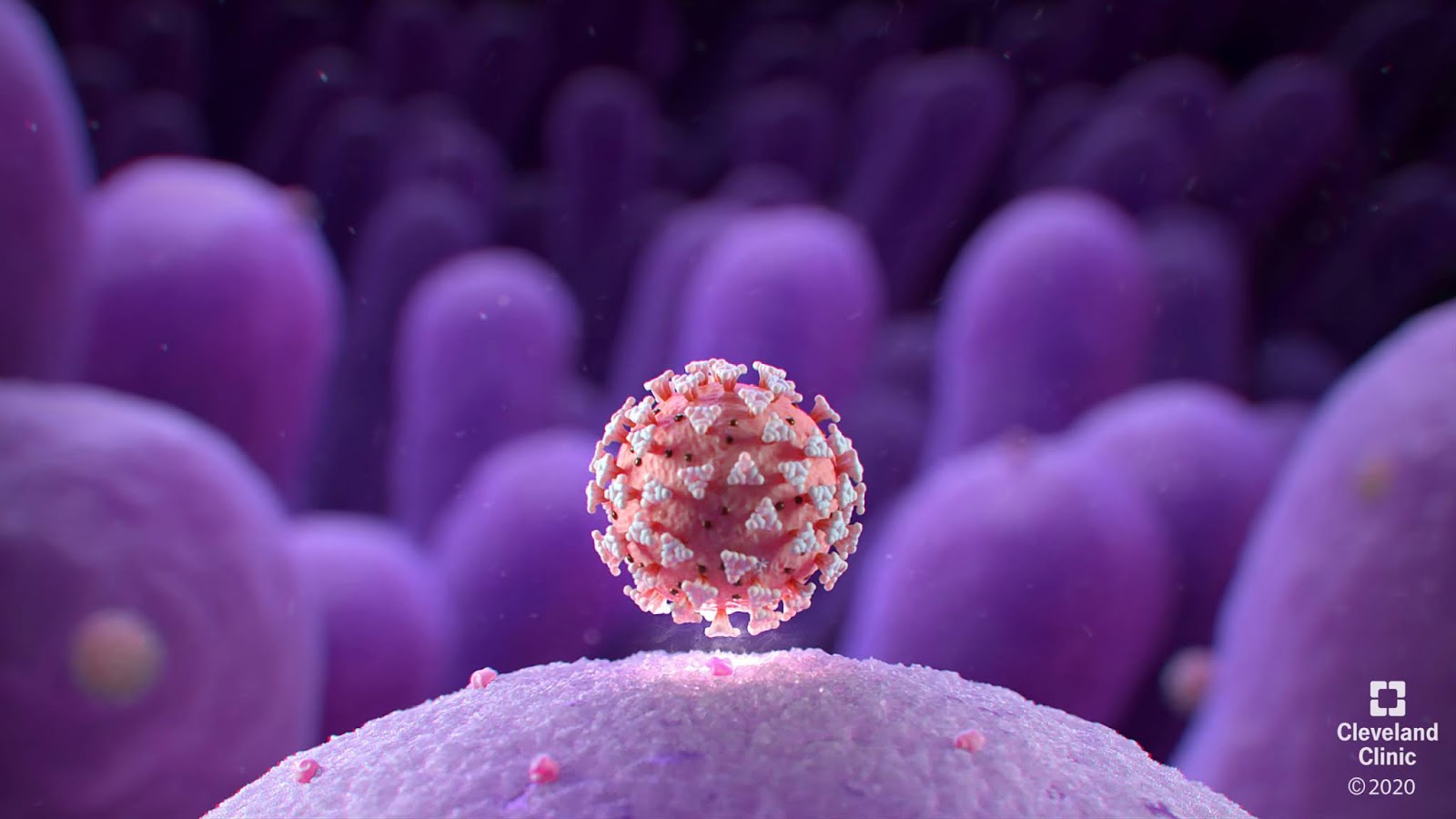
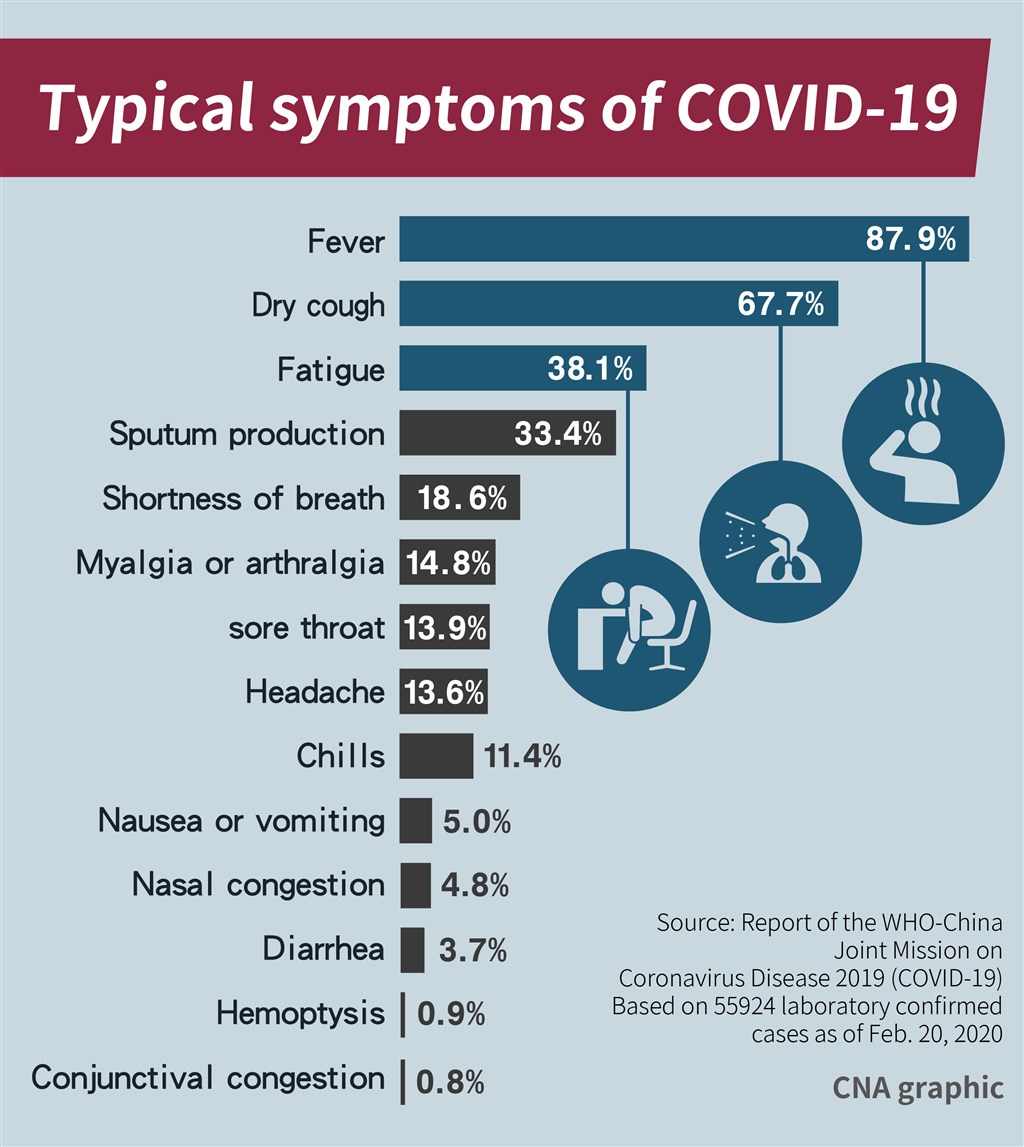
We have different questions in our mind but before answering all the answers , lets first discuss what is COVID 19? COVID 19 is an infectious disease caused by a new virus. This disease causes respiratory illness with symptoms such as cough, fever, and in more severe cases , difficulty breathing. This is the general definition of COVID 19 but do we need to know more about it? So what are the research that world is doing? what are the findings of researchers in this fact? As the research done by china, there are some stats related to the symptoms are:
88% of the cases have fever
68% of the cases have dry cough
38% of the cases have fatigue
33.4% of the cases have sputum production
and so on.
.
.
.
Here we can say that the people who are suffering from fever and dry cough has a very high chance of corona. But, in general, if we see the symptoms of common cold then runny nose is the major factor, but looking at the symptoms of corona , runny nose symptoms constitutes only 5%.
Shortness of breath is also a symptom.
WHO also told that in 80% of the cases of covid 19, we have only seen mild symptoms.
14% of the cases have severe symptoms and,
4.8% of the cases need critical care and,
rest have a possibilty to death.
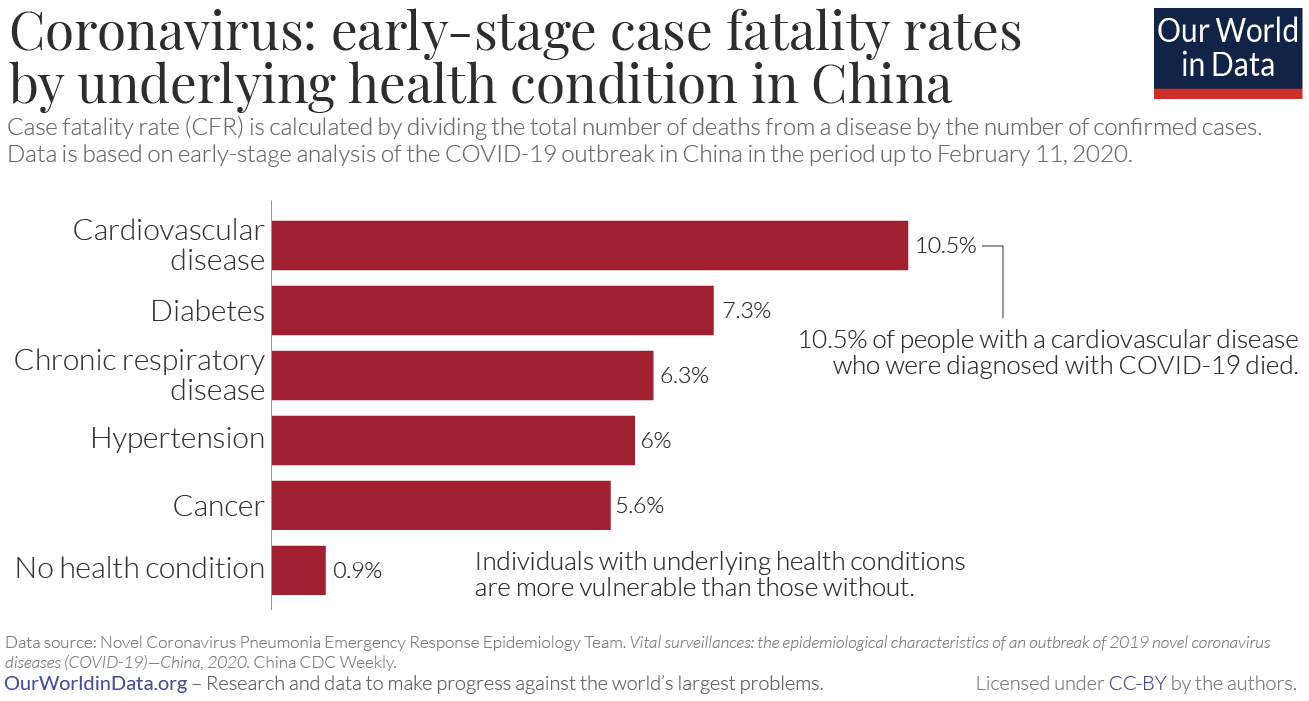
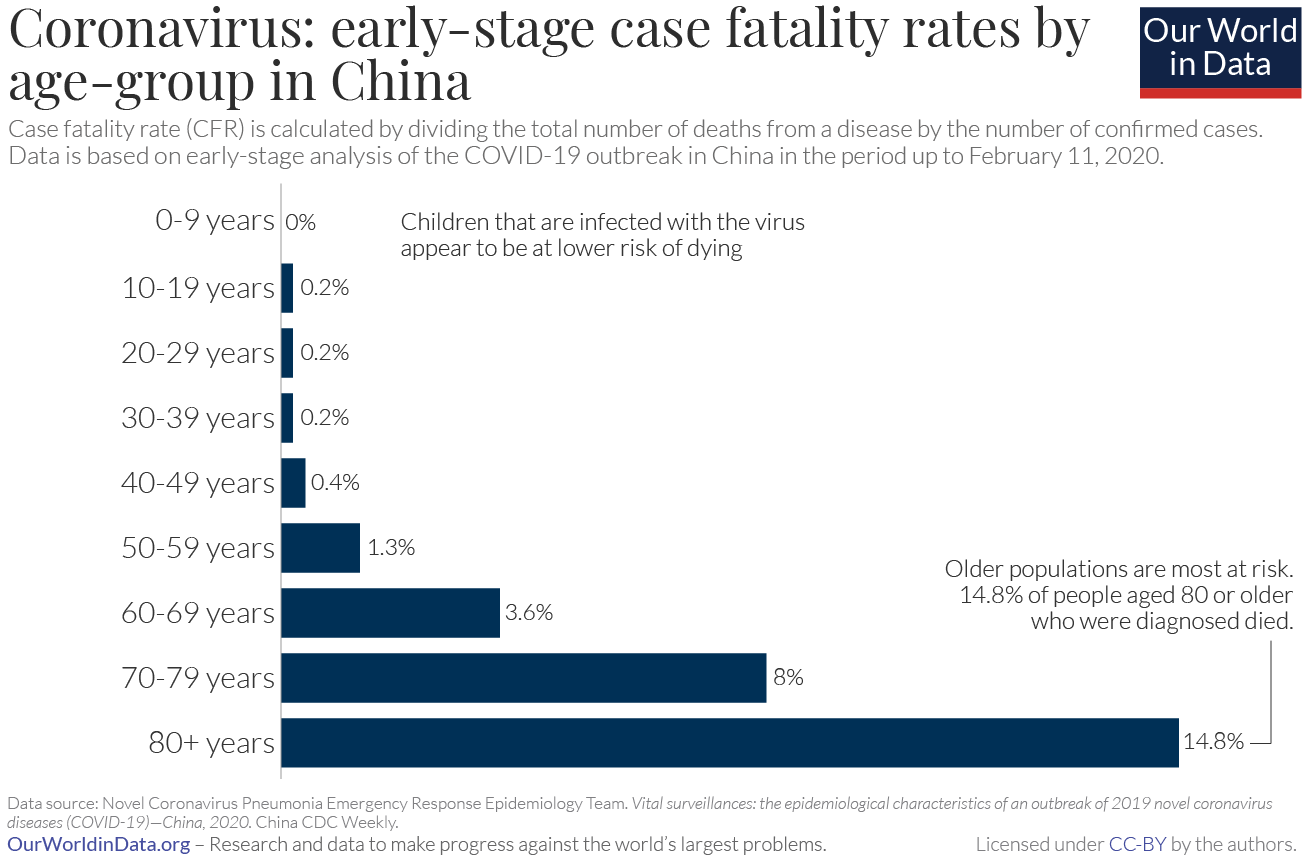
The fatality rate are mostly dependent on age and health conditions:
If I consider today’s data then there are more than 800000 of the COVID 19 cases with a death of more than 39500 people where US topped the list ( in the cases) and Italy topped in the no of deaths. How doctors recover the patients? what drugs they use?
People who are having good immunity system are able to recover fast and the drugs that are used for the treatment are the combination of the drugs used for ebola, malaria, HIV etc. and suggesting them to be in quarantine for minimum 14 days So, what should we do ? What are the measures to be taken?
One and only way ……… SOCIAL DISTANCING
This is the only way through which we can prevent ourselves
That’s why government imposed lockdown in their countries.
India and South Africa have introduced 21 days lockdown period so that this epidemic would not get spread and the rate will automatically go down.
China, Italy, france , Newzealand , UK, USA etc have implemented the world’s largest and most restrictive mass quarantines.
Wuhan, china, where the virus first appeared, has been lock down for more than six weeks, and many other chinese cities still face travel restrictions.
New Zealand enacted a mandatory 14-day quarantine for all individuals entering the country.
The UK went into full coronavirus lockdown on March 23.
On March 16, the European Union banned non-essential travel into the region for at least 30 days.
Germany announced a shut down of shops, churches, sports facilities, bars, and clubs in 16 states.
Almost every country has imposed lockdown to prevent their country.
Now, what are the economy effects that the world would face?The most effected sectors would be
:1) Aviation
Emirates sends most of the employees on unpaid leaves
United Airlines planning to take out their employees
Go Air and Air Indigo cut down their employees March- month salary by 50% and 25% respectively.
2) Hotel industry
Hotel Industry is also getting effected as no one now a days stay on hotels resulting into zero business
Union Square Hospitality Group planning to take out 80% of their employees
Le Meridien and Holiday Inn also planning to take out their employees
3) Event management, Entertainment and textile industry
4) Manufacturing Industry
5) Automobile Industry
6) Travel and tourism
7)BIRD also fired 30% of their employees There are some sectors which would not get effected much-
1)Telecom sector
2) Pharmaceutical sector
3)Health care sector
4)Companies which do work from home
-Amazon is getting benefited as many online orders are being placed and Amazon is also planning to hire employees for operations There are some other companies also which promised not to fire their employees in 2020
Tata
citi
visa
Wells Fargo
Goldman sachs
Bank of America
Morgan Stanley
Salesforce also promised not to fire their employees for 90 days.
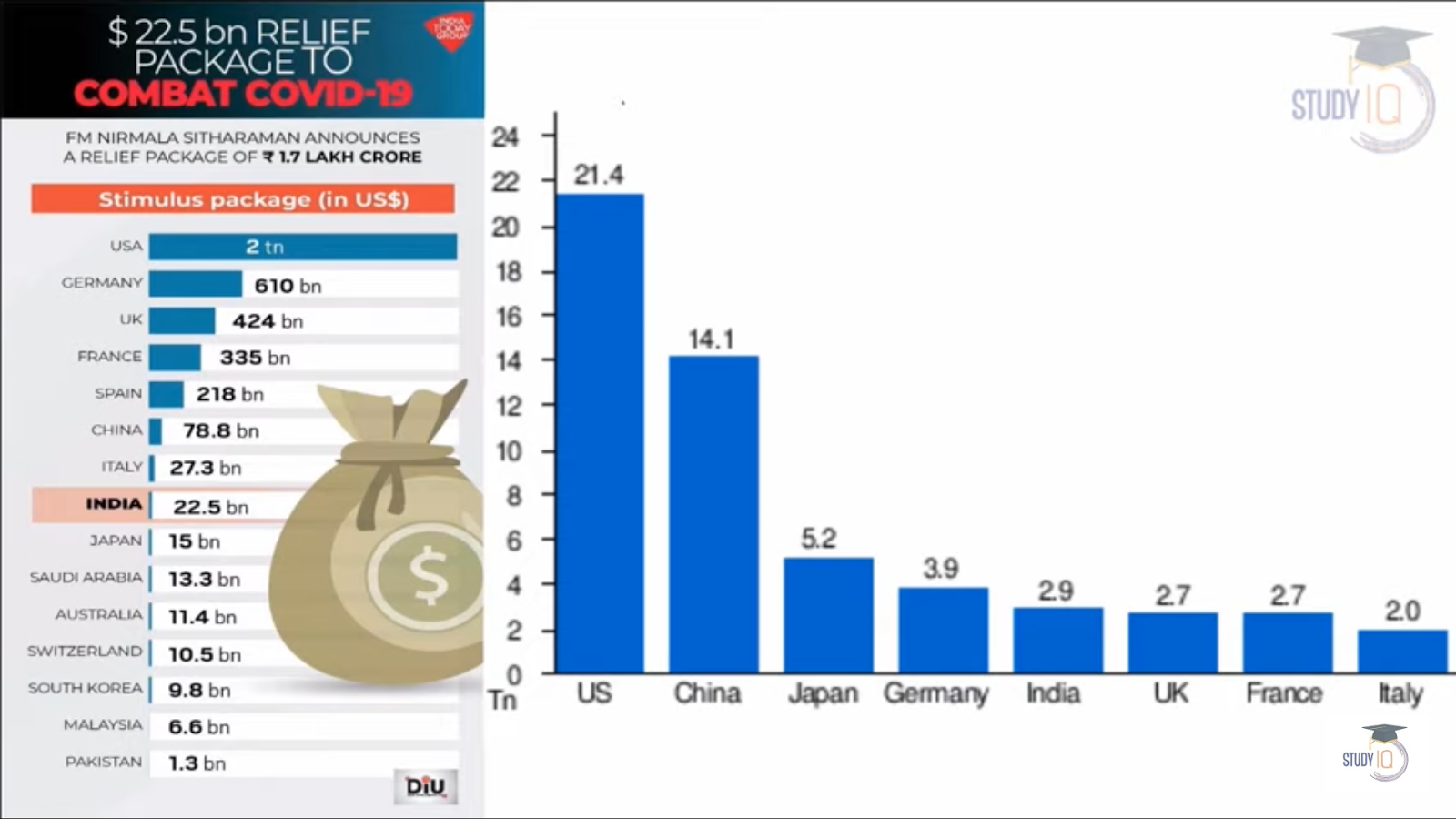
Now coming to the unemployment rate, then In US, 32 lakh people filed claim to be unemployed between 15 to 21 March .India has seen unemployment rate of 7.8% but this year it might go 8 or might be above 10 Moody’s also estimates India’s GDP might be grow at 2.5%Some other institution estimated it to be 4 to 4.4% What govt is doing for all these.?Govt introduced some relief package to boost the economy:
Here, US topped the list by introducing $2.2 trillion which is approximately 10% of their GDP ( because large no. of people are effected in US) and India introduced 1.7 lakh crore which is approximately 0.8% of their GDP. Our central bank, RBI also made some changes to boost economy.
The MPC decided by 4-2 majority to reduce repo rate by 75 basis points to 4.4 per cent.
The reverse repo rate was cut by 90 bps to 4 per cent, creating an asymmetrical corridor.
A moratorium of three months of EMIs on all outstanding loans was announced.
Now let’s see, what will happen? How things will go now?HOPE FOR THE BESTAND, FOLLOW SOCIAL DISTANCING AND STAY IN HOME.







 SANJAY KUMAR